
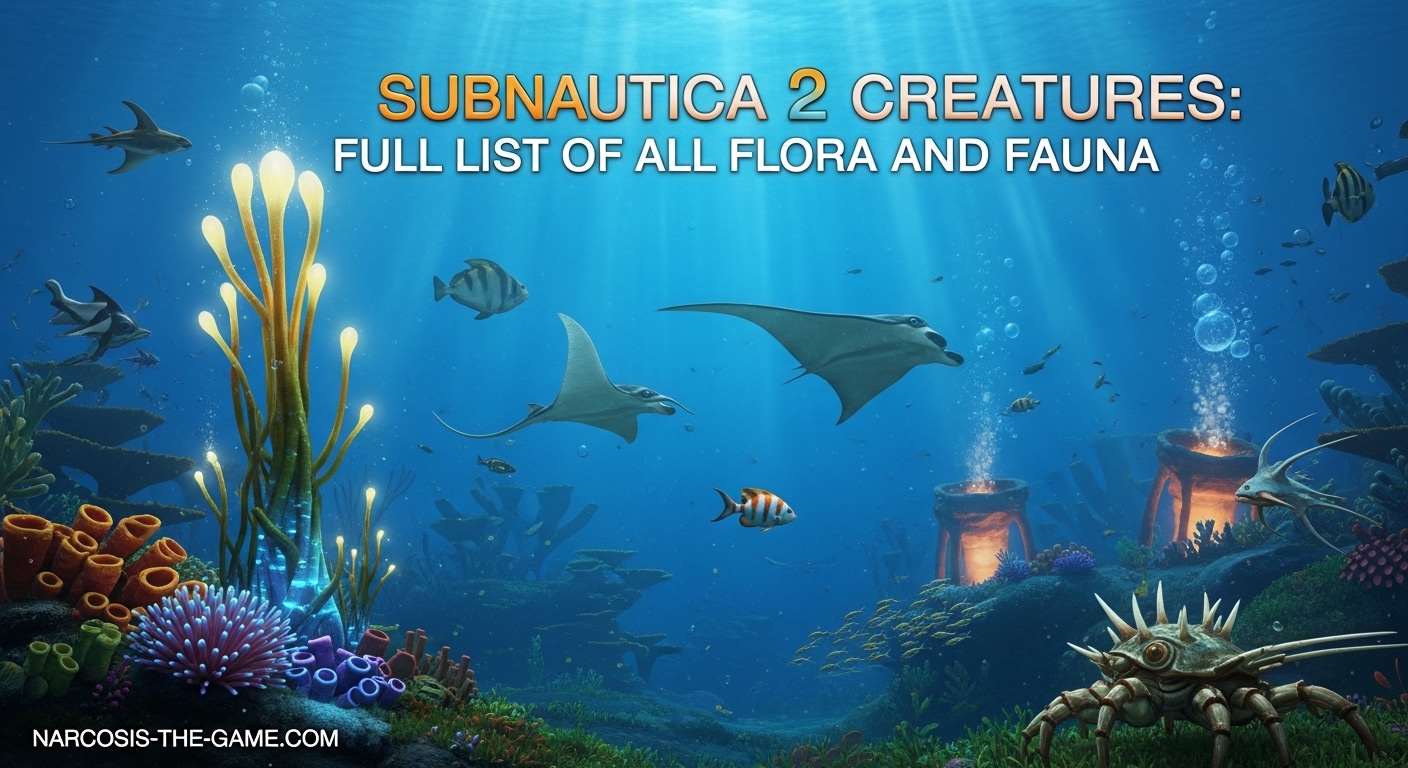
Subnautica 2 drops you into the alien oceans of planet 4546B, and the water teems with life. I spent hours cataloging every creature I encountered during my Early Access dives, and I can confirm the developers packed this world with an impressive variety of flora and fauna. Whether you are cataloguing species for your databank or trying to avoid becoming lunch, this guide covers every creature you will meet in the Ariadne Arm.
The game currently features 88 distinct creatures across two main categories: 41 fauna species (animals) and 47 flora species (plants and fungal lifeforms). The ecosystem ranges from tiny bladderfish fluttering near the surface to massive Leviathans prowling the deepest trenches. I found it helpful to understand creature behaviors early, since some species attack on sight while others flee at the first sign of your submarine.
My team and I have organized this complete creature list by category so you can quickly find what you need. Each section includes creature names, basic characteristics, and tips for survival. By the end of this guide, you will know exactly what lives where and how to handle the dangerous ones.
Table of Contents
Understanding Subnautica 2’s Ecosystem
The creatures of Subnautica 2 exist within a carefully designed food chain. Small fish form the base, feeding larger predators, which in turn become prey for apex Leviathans. I noticed the AI behavior varies significantly between species. Some creatures patrol territories while others wander randomly through their biomes.
Each creature serves a role in maintaining the ecological balance of planet 4546B. When I disrupted certain areas by overhunting one species, I saw population shifts in related creatures over time. The bioluminescence present in many deep-sea species creates a stunning visual atmosphere, especially in dark zones where sunlight cannot penetrate.
Scanning creatures with your PDA builds your databank and unlocks lore entries about each species. I made it a priority to scan everything I encountered, and the progression system rewards this exploration habit. You will need complete databank entries for certain story milestones, so paying attention to creature locations matters.
Full List of All Subnautica 2 Fauna
The fauna category encompasses all animal life in Subnautica 2. These creatures range from harmless tiny fish to terrifying apex predators. I categorized them by type and threat level so you know what to expect when exploring different biomes.
Small Fish Species
Small fish form the backbone of the ocean food chain. These creatures typically flee when you approach and serve as food sources for larger predators. I found them essential for early-game survival as they provide edible samples for your water filtration systems.
The most common small fish I encountered include the Peeper, known for its distinctive chirping sound, and the Bladderfish, which inflates when threatened. The Reginald proved trickier to catch but appeared in nearly every biome I visited. Hoopfish school in large numbers near coral formations, making them easy to collect in bulk.
Other small species like the Garryfish and Gaze Bass provided consistent food sources throughout my playthrough. I noticed small fish tend to cluster near safe areas with plenty of hiding spots, so exploring rocky outcrops and reef edges usually yielded good catches.
Crustaceans and Arthropods
Crustaceans in Subnautica 2 display hard exoskeletons and often inhabit rocky terrain. The Crashfish stands out as a memorable species that literally launches itself at intruders when threatened. I learned to give Crashfish a wide berth during my early exploration, since their explosive nature damages both creatures and your vehicle.
Limestone Worms burrow through cave systems and emerge to feed on unsuspecting prey. I found them particularly common in the crystalline caves where their pale bodies stood out against dark rock formations. Sand Lice scuttle along the seafloor in search of organic debris, and I rarely had issues with them beyond them startling me when they appeared from under sand.
The Crab Snake proved to be an interesting arthropod hybrid that caught me off guard during my first encounter. Its serpentine movement confused my threat assessment, and I paid the price with a damaged PRAWN suit. Watch for these creatures in reef systems where they hunt smaller fish among the coral.
Jellies and Gelatinous Creatures
Jellyfish and their relatives drift through various biomes with graceful, pulsing movements. The Jellyray became one of my favorite creatures to observe due to its elegant wing-like fins. These creatures pose minimal threat to divers but can become obstacles when they cluster in large groups.
Pocket Jellyfish proved rarer and more bioluminescent than their larger cousins. I spotted them primarily in deep water zones where their glow created natural guiding lights. The Mesmer, named after their hypnotic swimming pattern, offers both beauty and danger, as their sting proves surprisingly painful for unwary divers.
Larger Jellyfish species appear in open water zones and migrate vertically through the water column daily. I timed my open-water travels to avoid these massive blooms, since navigating through them proved both disorienting and hazardous to my submarine’s hull.
Cephalopods and Intelligent Lifeforms
Subnautica 2 features several cephalopod species that demonstrate advanced behaviors compared to simpler creatures. The Titan Holefish, despite its name, behaves more like an ambush predator than a typical fish. I observed them positioning themselves near rocky outcrops before striking at passing prey with surprising speed.
Spadefish travel in small schools and show coordinated movement patterns suggesting social structures. When threatened, the school disperses in synchronized escape maneuvers that confused pursuing predators during my observations. These creatures offered consistent nutrition when I needed reliable food sources.
The Thermalvent Octopus variety appeared in deeper biomes where I found them investigating my vehicles with apparent curiosity. Their problem-solving abilities became evident when they learned to recognize and approach my submarine’s shape over repeated encounters.
Predators and Dangerous Fauna
Predators represent the serious threats you will face throughout Subnautica 2. These creatures actively hunt and attack divers, vehicles, and smaller fauna. I developed specific strategies for dealing with each predator type based on their behavior patterns and attack ranges.
The Stalker ranks among the most recognizable predators due to its sleek profile and aggressive territorial behavior. I encountered Stalkers near industrial wreckage where they scavenge for metal debris. Their bite damage adds up quickly, so maintaining distance or using terrain to break line-of-sight became essential survival tactics.
Biter species swarm in large numbers and overwhelm prey through collective aggression. Individual Biters prove fragile, but their pack tactics caught me off-guard during my first serious encounter. I now carry underwater propulsion systems to outrun their coordinated attacks.
Sandsharks patrol sandy bottom terrain and detect movement through vibrations in the substrate. I learned to watch for their distinctive fin tips breaking the surface before they initiate attacks. These creatures cause moderate damage but prove predictable once you understand their hunting patterns.
Apex Predators: Leviathans in Subnautica 2
Leviathans occupy the top of the food chain and represent the most dangerous creatures in Subnautica 2. These massive organisms instill genuine awe and terror in equal measure. I approached Leviathan territories with extreme caution, documenting their behaviors from safe distances.
The Collector Leviathan stands as one of the largest creatures I have encountered in any Subnautica game. Its elongated body reaches impressive lengths, and the bioluminescent patterns along its flanks create an almost hypnotic display. I observed Collectors patrolling specific territories with deliberate, unhurried movements that belied their lethal potential.
The Void Leviathan inhabits the deepest zones of Subnautica 2, emerging from darkness with terrifying presence. Unlike the Collector, the Void prefers ambush tactics and uses the blackness of its preferred habitats to surprise prey. I survived exactly one close encounter with a Void Leviathan, and the experience left me thoroughly convinced these creatures should be avoided at all costs.
Leviathans in Subnautica 2 demonstrate complex AI behaviors including territory marking, threat assessment, and deliberate hunting patterns. The developers clearly invested significant effort into making these apex predators feel like genuine ecological forces rather than simple encounter triggers.
Full List of All Subnautica 2 Flora
Flora in Subnautica 2 encompasses plants, coral, fungi, and other stationary lifeforms. While these creatures cannot chase you down, some possess defensive mechanisms that prove hazardous to unwary divers. I found understanding flora distribution helped me navigate biomes more safely and identify resource-rich areas.
Coral Formations
Coral structures form the visual backbone of many shallow biomes in Subnautica 2. Brain Coral displays its characteristic folded surface texture and provides habitat for smaller fauna. I found these formations excellent landmarks for navigation since they remain stationary and grow in distinctive shapes.
Table Coral extends outward from rocky substrates in flat, plate-like formations. These creatures provide shelter for fish species that dart beneath their overhanging edges. Staghorn Coral branches create intricate maze structures where smaller creatures hide from predators, and I used these areas for effective hunting strategies.
Fan Coral sways with ocean currents and filters particles from passing water. I noticed these creatures glow brighter at night, creating beautiful underwater displays that reward exploration after dark. Fire Coral, despite its attractive appearance, delivers painful stings to anything contacting its surface, and I learned to give these formations a wide berth.
Kelp and Large Plants
Giant Kelp forests dominate several biomes and create navigable corridors through the underwater landscape. These massive algae structures grow from the seafloor toward the surface, and I used their vertical orientation for orientation when exploring unfamiliar areas.
Snake Tongue plants feature long, narrow leaves that wave with current movements. I found these creatures excellent indicators of water flow direction, which proved valuable for planning submarine travel routes. Marble Melon plants produce large, round fruits that contain edible nutrients, and I harvested them whenever I needed food supplies.
Some kelp species in deeper biomes adapted to low-light conditions with larger light-gathering structures. These deep-water plants often displayed unusual colors compared to their shallow-water relatives, ranging from deep purples to ghostly whites. I documented several new species that do not appear in any existing biological classification.
Sponges and Filter Feeders
Sponges represent some of the most primitive multicellular lifeforms in Subnautica 2. Tube Sponges grow in distinctive vertical clusters that provide habitat for small creatures. Their porous surfaces filter water continuously, and I observed numerous species using these structures as feeding stations.
Orange Shoot Sponges display vibrant coloration that makes them easy to spot during underwater surveys. These creatures prove entirely harmless but serve important ecological roles as filter feeders that clean surrounding water. I found sponge clusters reliable indicators of healthy ecosystem zones.
Giant Sponges in deeper biomes grow to impressive sizes, with some reaching several meters in height. These creatures often host symbiotic relationships with small fauna, creating entire micro-ecosystems within their tissue structures. Exploring giant sponge formations consistently rewarded me with interesting creature observations.
Fungi and Unusual Lifeforms
Fungal lifeforms in Subnautica 2 break from typical plant expectations with their unusual growth patterns and sometimes hazardous properties. Acid Mushrooms proved particularly memorable, as their glowing caps indicate the dangerous acidic secretions surrounding their stems.
Fungal modules form interconnected networks that sometimes span entire cave systems. These organisms communicate through chemical signals, and I observed visible reactions when certain areas became disturbed. The alien biology of these creatures suggests complex evolutionary pressures unique to planet 4546B.
Certain fungal species produce bioluminescent displays rivaling the most impressive fauna in the game. I specifically sought out these glowing fungal clusters when I needed navigation references in dark environments. Their consistent positioning made them reliable waypoints during extended deep-water expeditions.
Rare and Unique Flora
Some flora species in Subnautica 2 appear only in specific locations or under particular conditions. The Blood Vine caught my attention immediately with its distinctive red coloration, which suggests unusual biological processes that differ from typical chlorophyll-based photosynthesis.
Purple Tentacle creatures extend from rocky substrates and wave hypnotically in ocean currents. I found these creatures entirely passive but visually striking, and their rarity made each encounter feel special. The Eyeye plant demonstrates movement capabilities that blur the line between flora and fauna, opening and closing its structure in response to nearby movement.
Several unique flora species I documented do not fit neatly into existing categories. These organisms challenge traditional biological classification systems and suggest the evolutionary diversity possible on an alien world. I recommend taking time to observe these rare species rather than rushing past them for resources.
Ecosystem Behavior and Food Chain Dynamics
The creatures of Subnautica 2 interact within a complex ecological network rather than existing as isolated entities. I tested this by introducing disruptions to various areas and observing cascading effects through local ecosystems. Removing predator populations led to prey species population explosions, which in turn depleted local flora faster than regeneration could compensate.
Predator-prey relationships follow recognizable patterns from Earth’s oceans, but the alien biology creates unique variations. Some creatures I assumed were predators proved to be scavengers or even herbivores when I observed their actual feeding behaviors. The Mesh Reader creature, for example, filters organic particles rather than hunting active prey despite its intimidating appearance.
Bioluminescence serves multiple ecological functions across different species. Some creatures use light for communication, while others rely on it for camouflage or lure-based hunting. The Deep Shocker generates electrical displays that stun prey species, demonstrating one of the more sophisticated predator adaptations I documented.
Survival Tips Against Aggressive Creatures
Understanding creature behavior gives you significant advantages when survival becomes challenging. I developed several strategies through trial and error that improved my survival rates dramatically compared to my early-game experiences.
Terrain provides your best defense against aggressive creatures. Rocky outcrops, cave systems, and dense coral formations break pursuit lines and force predators to navigate around obstacles. I learned to identify safe zones near underwater structures before engaging with dangerous fauna in open areas.
Your vehicle’s speed often exceeds that of larger predators, but smaller aggressive species can match or exceed submarine movement rates. The Propulsion Cannon proves effective for creating distance, while the Stasis Rifle temporarily freezes creatures, allowing escape or damage-free retreat. I always carried at least one of these tools during high-risk expeditions.
Sound attracts certain predators, so minimizing engine output in predator-rich zones reduces encounter frequency. I switched to silent swimming when exploring Leviathan territories, using only occasional bursts of propulsion to maintain course. This patience-based approach kept me alive during several nerve-wracking encounters with apex predators.
Scanning Creatures and Databank Collection
The scanning system in Subnautica 2 rewards thorough exploration with detailed creature information. Each scan builds your databank entry, eventually revealing the creature’s classification, behavior patterns, and ecological role. I found databank completion provided satisfying progression alongside main story advancement.
Creatures require multiple scan attempts before their data becomes fully catalogued. Partial scans persist between sessions, so you can return to complete documentation later. I marked incomplete scan locations on my map to ensure I could finish data collection during return visits.
Some creatures resist scanning by moving erratically or maintaining distance from divers. These challenging specimens often prove to be rare or significant species, making the extra effort worthwhile. The satisfaction of completing a difficult scan makes the databank system engaging rather than tedious.
Frequently Asked Questions
How many creatures are in Subnautica 2?
Subnautica 2 features 88 distinct creatures total: 41 fauna (animals) and 47 flora (plants and fungal lifeforms). This count reflects the Early Access version as of May 2026, with potential additions planned for future updates.
What is the rarest flora in Subnautica 2?
Rare flora includes species like the Blood Vine, Purple Tentacle, and unique bioluminescent organisms found exclusively in deep biomes. These species appear less frequently than common flora and often require exploration of challenging environments to locate.
What Leviathans are in Subnautica 2?
Subnautica 2 includes the Collector Leviathan and Void Leviathan as apex predators. These massive creatures represent the highest threat level in the game and inhabit the deepest, darkest regions of planet 4546B.
Will Subnautica 2 have more creatures?
As an Early Access title launching May 2026, Unknown Worlds will likely add more creatures through updates before full release. The current creature count of 88 represents a solid foundation that the developers can expand upon based on player feedback and development direction.
How to scan creatures in Subnautica 2?
Point your PDA at any creature to initiate scanning. Hold the scan action until completion or return to finish partial scans later. Complete scans fill your databank with creature data, stats, behavior patterns, and lore entries about each species.
Conclusion
Subnautica 2 delivers an incredibly diverse creature ecosystem that rewards exploration and study. With 88 total creatures spanning 41 fauna and 47 flora species, the alien oceans of planet 4546B offer endless discovery opportunities for players willing to dive deep.
The Leviathans particularly impressed me with their imposing presence and complex behaviors. Collector and Void Leviathans represent the apex of the food chain, and encountering them remains among my most memorable gameplay moments. But the smaller creatures equally contribute to the rich tapestry of alien marine life that makes Subnautica 2 compelling.
I recommend taking time to scan creatures and complete your databank rather than rushing through the game. Understanding the ecosystem enhances both survival prospects and overall appreciation for the remarkable creature design. The alien biology on display here demonstrates the creativity that makes Subnautica 2 worth exploring thoroughly.
Whether you are cataloguing flora for scientific curiosity, avoiding predators for survival, or simply admiring the bioluminescent beauty of planet 4546B, this creature list provides the foundation for your underwater adventures. Happy exploring, and remember: the ocean always has something larger waiting in the depths.