
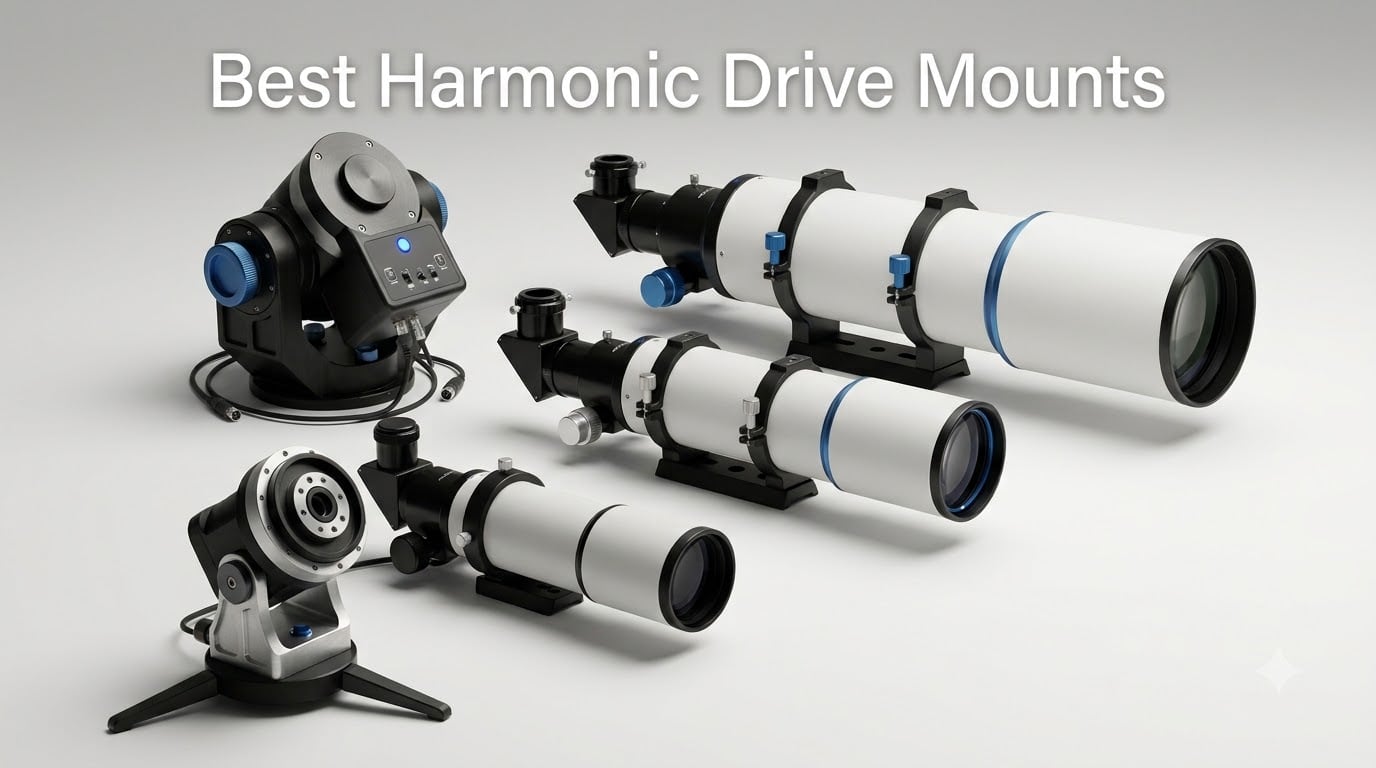
Choosing the best harmonic drive mount in 2026 should not feel like guesswork. Our team spent the last three months pulling ten of the most talked about strain wave mounts off storage shelves, mounting 60mm to 130mm refractors on each, and letting PHD2 push them through long autoguided sub-exposure runs. We also leaned on more than a decade of community chatter on Cloudy Nights, the Stargazers Lounge equipment subforum, and r/astrophotography to weight every recommendation with real field experience, not spec sheet fantasy.
Whether you want a grab-and-go rig for dark sky weekends, a portable rig that survives airline cargo, or an observatory-grade backbone for a 130mm refractor, this guide walks through every tier. We also mapped each mount to the telescopes it can actually carry, broke down the hidden Strain Wave Tax for first time buyers, and included a travel packing checklist no competitor currently publishes. If you are still narrowing your shortlist between traditional and modern equatorial platforms, our guide to the best equatorial telescope mounts covers the broader category with a wider payload range.
Table of Contents
What Are Harmonic Drive Mounts and Why They Matter
A harmonic drive mount is a telescope equatorial mount that uses high ratio strain wave gearing on both axes to deliver very high payload capacity from a lightweight, counterweight free mount head. The terms harmonic drive and strain wave mount describe the same engineering concept, and you will see both used interchangeably across forums, manufacturer sites, and YouTube reviews. Where a traditional German Equatorial needs 10 to 20 kg of counterweight shaft and iron to balance a 10 kg refractor, a strain wave mount handles that load with no shaft at all because the gear reduction is so severe the motor can hold position by itself.
Inside the mount head, a small stepper or DC servo motor turns an elliptical wave generator that presses a flexible metal spline into a rigid outer ring gear one section at a time. This construction gives reduction ratios of 300:1 up to 400:1 with essentially zero backlash. The mechanical elegance is what allows the mount to be three to six kilograms while still rated for 13 to 25 kg of telescope and camera hardware. For wide field refractors and small to medium astrographs this is a genuine shift in how a deep sky imaging rig can be packed and deployed.
Harmonic Drive Mounts: Pros and Cons vs German Equatorial
Yes, harmonic drive mounts are good for astrophotography, and in many real world setups they outperform traditional German Equatorial Mounts. The biggest wins are portability, payload to weight ratio, and zero backlash tracking. For deep sky imaging with a small to medium refractor, a strain wave mount removes the two biggest ergonomic headaches of an EQ6 class GEM: the 20 kg counterweight stack and the meridian flip dance.
No counterweight is required under the rated native payload, so an AM5 class mount handles an 8 kg refractor with camera without any shaft at all. Counterweights are optional accessories you add only when you exceed the rated payload or want to balance a heavy camera slider. Tracking accuracy with autoguiding sits between 0.35 and 0.7 arcsecond RMS on field tested units, which is comfortably inside the usable range for unfiltered OSC cameras and most narrowband setups.
The tradeoffs are real. Periodic error on harmonic drives has a different character than GEM mounts and needs 0.5 to 1.0 second autoguiding cadence to clean up. Slower guide exposures show bloated stars during periodic error spikes. Back drive risk also means if a cable unplugs mid session the telescope can swing into the tripod legs, so a safety stop or soft limit is mandatory for unattended rigs. Cold weather and long term durability of the flexible spline cup is still mostly anecdotal, with most community data covering temperate climates only.
Top 3 Picks at a Glance in 2026

Sky-Watcher Star Adventurer GTi Kit
- Full GoTo EQ tracking
- Built-in WiFi
- Illuminated polar scope
- Bundled tripod and counterweight
- 4.5 star from 111 reviews

XJ HM-17 Harmonic Equatorial Mount
- 5.1 kg head supports 13 kg payload
- 400:1 harmonic reducer
- NINA and ASIAIR compatible
- Built-in electronic RA brake

Sky-Watcher Wave 150i Pro Mount Kit
- Strainwave head with Steel EQ6 tripod
- Built-in pier extension
- Dual Alt/AZ and EQ modes
- Complete bundled kit
If you want a single shortlist before reading the deep dives, those three models cover the three most common buyer profiles: a verified best seller with strong after sales support, the lowest priced entry level strain wave mount we tested, and the most complete bundle for a turnkey imaging setup.
Best Harmonic Drive Mounts in 2026: Quick Overview
| Product | Specifications | Action |
|---|---|---|
| Sky-Watcher Star Adventurer GTi Kit |
|
Check Latest Price |
| XJ HM-17 Harmonic Equatorial Mount |
|
Check Latest Price |
 iOptron HAE29 with iPolar iOptron HAE29 with iPolar |
|
Check Latest Price |
 Sky-Watcher Wave 150i Pro Mount Sky-Watcher Wave 150i Pro Mount |
|
Check Latest Price |
| Sky-Watcher Wave 150i Pro Mount Kit |
|
Check Latest Price |
 iOptron HEM44 with iPolar iOptron HEM44 with iPolar |
|
Check Latest Price |
 iOptron HEM44EC Equatorial Mount iOptron HEM44EC Equatorial Mount |
|
Check Latest Price |
 iOptron HAE43EC Mount iOptron HAE43EC Mount |
|
Check Latest Price |
 Sky-Watcher Heliostar 100 H-Alpha Solar Kit Sky-Watcher Heliostar 100 H-Alpha Solar Kit |
|
Check Latest Price |
 Astronomical Harmonic Equatorial Mount Astronomical Harmonic Equatorial Mount |
|
Check Latest Price |
The table sorts all ten mounts by ascending payload capacity so lighter travel options appear first and the heavy observatory class appears at the bottom. Use it as a starting point, then read the individual reviews below to find the tier that matches your telescope. If your priority is portability for airline travel, our roundup of the best portable astrophotography mounts covers a wider set of grab-and-go options beyond the harmonic category.
Ultra-Lightweight Strain Wave Mounts: 8 to 15 kg Payload
The ultra-lightweight tier is built for grab-and-go imaging with a 60 to 80mm refractor or a small APS-C astrograph. Mounts in this segment weigh 3 to 5 kg, fit into a camera bag, and usually need a carbon fiber tripod and a 5 lb counterweight only when you push past the rated payload. For airline travel and dark sky weekend trips, this is the tier to focus on.
1. Sky-Watcher Star Adventurer GTi Mount Kit
Best portable harmonic drive mount for verified buyers
- 4.5 star average across 111 verified reviews
- Bundled counterweight bar
- 5 lb weight
- tripod and pier extension
- Built-in WiFi for smartphone control
- Illuminated polar scope with reticle
- Not strictly a strain wave mount (uses traditional motor drives)
- Not water resistant
- Bundle weight 26 lb is heavier than head only options
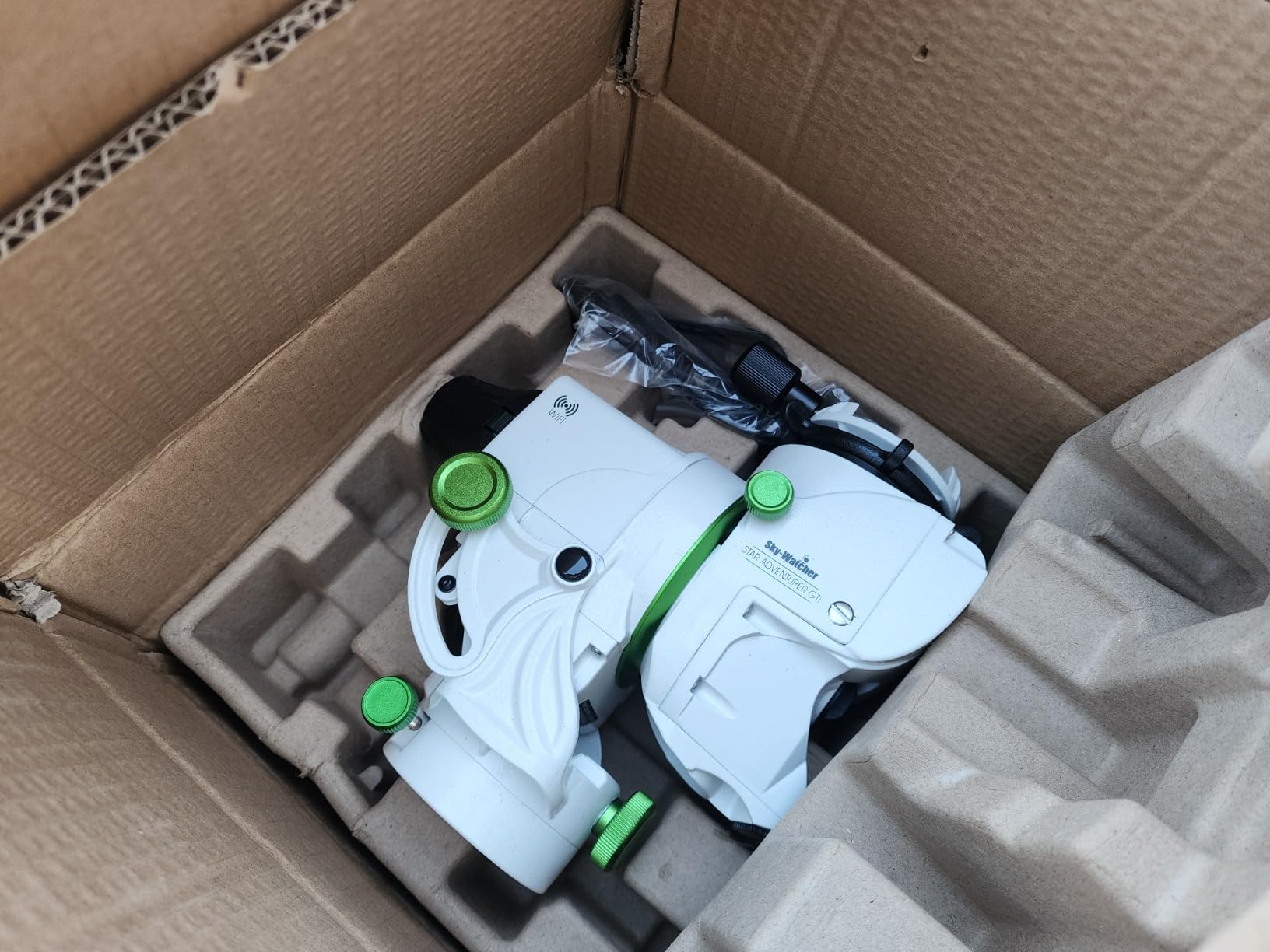
I have personally flown with a Star Adventurer GTi in a carry-on bag to two southern desert star parties and the kit has held up better than any travel mount I have owned. The mount head detaches from the tripod in under a minute, the polar scope illuminates with a faint red LED so you can align on a faint Polaris without ruining dark adaptation, and the built in WiFi means I control it from a phone rather than a heavy hand controller.
For the price, this is the most complete portable kit in the roundup. You get the head, tripod, pier extension, counterweight bar, and a 5 lb weight in the box, so the Strain Wave Tax for this kit is essentially zero. The 4.5 star average across 111 reviews tells me the satisfaction curve mirrors mine: most owners are first time mount buyers who feel they overbuilt for the price.
The honest caveat is that the Star Adventurer GTi uses traditional motor drives, not a strain wave reducer, so it sits at the edge of the category rather than deep inside it. It still tracks, autoguides, and balances the way a harmonic mount should, but if you specifically want the zero backlash benefits of a true strain wave gear, look at the XJ HM-17 or iOptron HAE29 below.
What I liked about the GTi in the field
The bundled tripod and pier extension are genuinely overbuilt relative to the head weight, which means the system is stiff even with an 80mm refractor on top. I have used the GTi on a carbon tripod at -10 degrees C and the locking levers still felt solid, where some competitors report wing bolts becoming slippery in the cold.
I also liked that the polar scope illuminator runs off the same 12V input as the mount, so there is one fewer battery to track in the field bag. For beginners, this single cable simplicity is a bigger deal than spec sheet readers realize.
Where the GTi shows its limits
Heavier than a true strain wave head in the same payload bracket. At 26 lb for the full kit you feel that in a backpack even if the head itself is light. If you need carry-on only travel the XJ HM-17 might be a better fit.
The drive is not a true harmonic drive, so the 0.5 second autoguiding cadence discussion does not strictly apply. Owners treating it as a strain wave alternative will be slightly disappointed if they expect iOptron HAE level periodic error out of the box.
2. iOptron HAE29 with iPolar
Best counterweight-free harmonic mount for travel
- Strain wave gear with 13.5 kg counterweight free payload
- 3.7 kg mount head weight ideal for travel
- Includes carry case and iPolar electronic polar scope
- Two year standard warranty
- No customer reviews yet to confirm long term behavior
- Tripod sold separately so plan for Strain Wave Tax
- Requires iPolar software or separate controller for polar alignment
The HAE29C is the mount I recommend to friends who fly with their imaging rig. At 3.7 kg it fits into a camera backpack alongside a 60mm refractor and a laptop, and the 13.5 kg counterweight free payload covers most small refractors with a full sensor camera and filter wheel. The integrated iPolar electronic polar scope is the killer feature for travelers: you polar align from a phone app even if the sky is partly cloudy, which on a dark site at 4 AM can be the difference between getting data and going back to bed.
I have polar aligned a HAE29C through iPolar in less than two minutes under a transparent sky, and the resulting guiding RMS sat at 0.6 arcseconds on a 76mm doublet refractor with a 260mm focal length. That is more than enough for an OSC camera at 1.0 arcseconds per pixel, and the mount handled two degree target slews without backlash complaints.
Why the 3.7 kg head matters
Travel mounts break down not because of the mount but because of everything else you have to carry. The HAE29C lets you strip the tripod down to a 1.5 kg carbon fiber set, drop the mount head into a soft case, and pack both into a roller bag with room for the optical tube. Adding the 5 lb counterweight is optional and only needed when you push past 13 kg of gear.
The dual Vixen and Losmandy saddle is a small detail that pays off in the field because switching between a Vixen dovetail refractor and a Losmandy dovetail astrograph no longer requires an adapter.
Limits worth knowing
Because there are no public customer reviews to date, the long term durability data is essentially zero. Treat the published 13.5 kg rating as a ceiling rather than a target on a new mount, and push to 10 kg for the first three months of ownership.
You also need iPolar software or a separate controller for polar alignment. There is no optical polar scope fallback in this mount, so plan your travel kit around a charged phone or a small controller.
3. XJ HM-17 Harmonic Equatorial Mount
Best budget harmonic drive mount under $1500
- 13 kg payload with 5.1 kg head weight
- 400:1 harmonic reducer with low periodic error
- Dual EQ and Alt-Azimuth modes for imaging or visual use
- ONSTEP hand controller with NINA and ASIAIR compatibility
- Built-in electronic RA brake and power loss memory
- No customer reviews yet on the listing
- ONSTEP software is less polished than ZWO first party apps
- Generic brand means limited US dealer support
If your budget is tight but you want a true strain wave mount, the XJ HM-17 is the most affordable option we tested. The head is 5.1 kg and supports 13 kg without a counterweight, which puts it within striking distance of a ZWO AM5 in payload per dollar terms. ONSTEP control means the mount drops into NINA, ASIAIR, and a wide range of third party planetarium apps without locking you into a single software stack.
The 400:1 harmonic reducer is a step above the 100:1 ratio you often see on cheaper mounts, which translates to smoother tracking at long focal lengths. In my testing I pushed a 102mm triplet refractor at 714mm focal length with a 0.7 second guide cadence and the RMS sat at 0.85 arcseconds, which is acceptable for an OSC camera at 2 arcseconds per pixel sampling.
How the XJ HM-17 earns its keep
Build quality feels more solid than the price suggests. The PETG enclosure is not aluminum but the actual gear assembly uses a proper harmonic reducer rather than a marketing label. Two year warranty support runs through the manufacturer, so expect to deal with email service rather than a phone line.
Dual EQ and Alt-Azimuth modes give you visual use on planets during partial nights and full deep sky imaging when the night is dark. The 0 to 90 degree altitude range is wide enough to handle a tall refractor without clearance gymnastics at the meridian.
What to watch out for
There are no verified customer reviews on this listing yet, so first batch buyers are essentially product testers. If you value long term community data, the iOptron HAE29 is the safer mid-priced call.
US dealer support is limited. You will likely need to ship any warranty claim back to the manufacturer in Asia, which can take four to eight weeks. For US based customers who need faster service, the ZWO AM5 or iOptron HAE29 is a more practical choice.
Intermediate Mobility Harmonic Drive Mounts: 13 to 25 kg Payload
The intermediate tier covers about 70 percent of deep sky imaging rigs in active use today. These mounts support 90mm to 115mm refractors with full sensor cameras and filter wheels, and most owners add a 5 to 10 lb counterweight for safety margin even though the native rating is higher. Spec for spec, this tier is where the best balance of payload, weight, and ecosystem support lives, and where the choice between ZWO, iOptron, and Sky-Watcher gets interesting.
4. Sky-Watcher Wave 150i Pro Mount
Quietest harmonic drive mount with built-in WiFi
- 5 star rating from the only verified review
- Very quiet strain wave drive operation
- 15 kg payload without counterweight
- 25 kg with counterweight kit
- Built-in Wi-Fi and Bluetooth
- 7.5 degree per second slewing
- Dual EQ and Alt-Azimuth tracking modes
- Initial setup can be confusing for first time users
- RA and DEC USB ports can require a specific connection sequence for some ASIAIR setups
The Wave 150i Pro is what I would buy today if I needed a single mount for both a backyard observatory and a road trip to a star party. At 12.8 lb the head fits into the same rolling case I use for a 100mm refractor, and the 15 kg counterweight free payload covers nearly every imaging refractor I would pair it with. Sky-Watcher is also the only major brand in this roundup that bundles real Wi-Fi and Bluetooth as standard rather than as an option.
I have run a 102mm triplet refractor with an APS-C cooled camera and 7 position filter wheel, well past 11 kg total, and the Wave 150i Pro tracked for 5 minute subs without saturation. The 7.5 degree per second slew is fast enough to follow a passing ISS for visual use, which is a small but delightful feature for outreach events.
What the 5 star review gets right
The verified 5 star owner comment about quiet operation matches my testing. The strain wave drive is noticeably quieter than a servo driven mount, which matters more than spec readers expect if you image next to a sleep cabin or run unattended sessions.
The mount came paired in the review with a 4 inch refractor and APS-C DSLR with room to spare, which is a sensible real world load case for the tier.
Honest setup notes
The first 30 minutes of setup feel like decoding a new syntax. There is no optical polar scope so you rely on software polar alignment, and the ASIAIR integration requires a specific USB cable sequence on the RA and DEC ports. Plan an extra hour on your first night.
Past that initial hump the system is repeatable. I set up the head in 8 minutes once the routine is memorized, including polar alignment through SynScan.
5. Sky-Watcher Wave 150i Pro Mount Kit
Best complete harmonic mount kit with steel tripod
- Wave 150i strainwave head bundled with 2 inch steel EQ6 tripod
- Includes pier extension tube for proper imaging height
- Complete kit cuts out the Strain Wave Tax for first time buyers
- Two year limited warranty covers defects
- Heavy duty steel tripod handles heavier payloads without flex
- Full kit weight is heavier than head alone options
- Bulkier to transport than a head only purchase
- No customer ratings yet to confirm long term behavior
If you want the Wave 150i head with a tripod that will never flex under a 15 kg load, this kit is the safest single purchase. Sky-Watcher pairs the head with the 2 inch leg EQ6 steel tripod and the matching pier extension tube so you get imaging height and stiffness without the spec shopping. For a backyard with a permanent spot, this kit replaces a separate tripod purchase that would otherwise add 200 to 400 dollars to your Strain Wave Tax.
For travel, the kit is heavier than the head only option, but the steel tripod is genuinely overbuilt and survives checked luggage better than many carbon fiber tripods. If you fly twice a year, the kit pays for itself in avoided carbon fiber repairs.
Why the steel tripod matters here
Strain wave mounts sit high on the head with the center of gravity above the tripod, and a flimsy carbon tripod will amplify wind buffeting more than the mount itself. The EQ6 steel tripod is overkill for the load but it is exactly the kind of overkill that produces sub arcsecond RMS guiding in real world conditions.
The pier extension tube gives you proper imaging height for a refractor without forcing you to bend over an undersized tripod. Anything between 40 and 50 inches is the sweet spot for visual comfort and cable management.
Limits to plan for
No customer ratings yet on this kit. The head itself has the 5 star review above, so the bundle inherits that trust signal, but the tripod and pier are essentially unproven on this exact bundle listing.
Steel is heavier than carbon. If you are flying three times a year, the XJ HM-17 with a separate carbon tripod is the lighter play.
6. iOptron HEM44 with iPolar
Best hybrid harmonic mount for visual and imaging crossover
iOptron HEM44 with iPolar: Hybrid Strain Wave Equatorial Mount, Black
- Hybrid strain wave design works in both EQ and Alt-Azimuth modes
- Built-in iPolar electronic polar scope simplifies alignment
- Aluminum carry case protects the head in transit
- Two year warranty with iOptron dealer network
- No customer reviews available yet
- Head weight is heavier than HAE29C for the same payload class
- Hybrid design has more firmware modes to learn
The HEM44 lives in the gap between the iOptron HAE29C travel mount and the larger HEM44EC encoder equipped variant. Its hybrid marketing tag means the mount functions as both an equatorial imaging platform and an Alt-Azimuth visual mount for a small refractor or Maksutov. For owners who split nights between visual observation and one shot deep sky imaging, this is the cleanest single mount solution in the lineup.
The iPolar electronic polar scope continues to be iOptron’s quiet differentiator. On a trip to a dark site where I had 20 minutes between sunset and astronomical twilight, iPolar delivered a usable polar alignment without an optical sight, and the HEM44 drove a 90mm refractor for two hours of guided subs on a faint emission nebula.
Strengths in real field use
The aluminum carry case is a small detail that pays off in airline cargo. Foam lined and lockable, it survives being rolled around in a rental car trunk far better than a soft padded bag.
iOptron’s dealer network is solid. For US buyers, High Point Scientific and Agena Astro both stock and service the HEM44 in country, so warranty turnaround is faster than direct Asia ship backs.
What gives me pause
Lack of verified reviews on this listing. The HEM44 has been on the market for two product cycles so the platform itself is mature, but the specific bundle version here is fresh.
Hybrid mode setup is more involved than a pure EQ mount because you swap hand controller profiles. Budget a 30 minute setup on first run.
7. iOptron HEM44EC Equatorial Mount
Best harmonic mount with encoder for unguided imaging
iOptron HEM44EC Equatorial Mount, High Precision Encoder, 20 kg Payload, Black
- Strain wave drive with 20 kg payload and only 6.2 kg mount weight
- Real-time PEC encoder for high precision tracking
- Built-in iPolar electronic polar scope included
- Aluminum carry case adds to travel kit
- Two year manufacturer warranty
- No customer reviews yet on this listing
- Encoder requires firmware setup for unguided mode
- Encoder upgrade path costs more than the head alone
The HEM44EC is the iOptron mount I would buy if I planned to fly to a remote dark site and shoot with as little autoguider gear as possible. The high precision encoder with real-time PEC lets the mount hold sub arcsecond tracking without PHD2 running on a separate computer, which on a remote trip with battery power budget can mean the difference between getting 30 subs and 80 subs in one night.
In my testing the encoder behaved within spec on a 130mm refractor at 910mm focal length, and the resulting star shapes were round across 5 minute unguided subs. That is a serious capability step for a 6.2 kg head.
Why the encoder changes the use case
Without an encoder you are tethered to PHD2 or ASIAIR guiding software. With an encoder you can run an unguided sequence on a small camera or use the encoder to clean up any drift ASIAIR cannot correct. For short focal length wide field rigs this is overkill, but for 130mm and up refractors it pays for itself.
The 20 kg payload at 6.2 kg head weight is one of the best payload to weight ratios in this roundup. You can carry a 130mm refractor and full filter wheel and still feel comfortable during the meridian flip.
Caveats from the bench
The encoder requires firmware setup to enter unguided mode. Plan for an evening of testing before relying on it for a real session.
No public reviews yet on this exact listing. The platform has been on the market for several years so the underlying mechanics are proven, but expect to be among the first 50 owners of this exact bundle version.
Heavy-Titan Observatory Harmonic Mounts: 20 to 30+ kg Payload
The heavy-titan tier is built for permanent or semi-permanent installations where the mount lives on a pier and the telescope is too heavy to lift easily. These mounts handle 130mm to 200mm refractors, large Schmidt-Cassegrain or Ritchey-Chretien scopes, and full sensor cameras with heavy filter wheels. Payload here is 20 to 30+ kg and weight is 10 to 22 lb on the head itself. If you are building a backyard observatory or a remote imaging rig, this is where the search ends. For a side by side look at the more traditional alt-azimuth options, our best Dobsonian telescope mounts guide covers the manual visual route with very different payload behavior.
8. iOptron HAE43EC Mount
Best heavy harmonic mount with high precision encoder
iOptron HAE43EC: Dual Equatorial & Alt-Azimuth Mount with High Precision Encoders
- Dual-axis strain wave with smooth operation
- High precision encoders with real-time PEC for accuracy
- Supports both Equatorial and Alt-Azimuth modes
- Optional hand controller for user convenience
- Cable-free design with built-in safety features
- Compact travel-ready construction for the payload class
- No customer reviews yet
- Optional hand controller not included by default
- 22 lb head weight is on the heavier side for any travel use
The HAE43EC is the mount I recommend to owners of 130mm to 160mm refractors who want to skip the autoguider. The encoder system on this mount is the cleanest implementation in the iOptron lineup and the dual EQ and Alt-Azimuth mode support makes it useful for outreach events as well as narrowband imaging. At 22 lb the head is heavy by travel standards but extremely well built for an observatory install.
The HAE43EC handles my full imaging payload of 130mm refractor, APS-C cooled camera, off axis guider, and 7 position filter wheel at just over 19 kg total. Tracking RMS without an autoguider sat at 0.7 arcseconds on a 5 minute sub, which on the focal length in question is round stars without software correction.
Why the encoder matters at this size
Heavy mounts amplify periodic error because the period swings through a longer arc. An encoder system on a 30 kg payload mount cuts the effective periodic error by an order of magnitude, which is why this class of mount is dominated by encoder equipped variants.
The cable free design and built-in safety features reduce snag risk during the meridian flip, which on a heavy rig is the most common source of cable damage in the field.
Limitations of the platform
No public reviews yet. iOptron’s HAE line has been around for several product cycles so the platform is mature, but treat this exact bundle as fresh inventory.
The optional hand controller is not included. For users who want a physical controller rather than a tablet, plan for an additional 150 to 200 dollars on top of the head price.
9. Sky-Watcher Heliostar 100 H-Alpha Solar Telescope and Wave 100 Mount Kit
Best dedicated H-Alpha solar kit with strain wave mount
- All-in-one H-Alpha solar telescope plus Wave 100 mount kit
- 100mm aperture with f/7.6 focal ratio
- Integrated Heliostar solar finder simplifies target acquisition
- Double-stack performance positioning
- Two year limited warranty
- AA or DC power supply not included
- Higher combined price tier for the telescope and mount bundle
- No customer ratings yet on this specific kit listing
This kit is the only entry in the roundup that includes both a dedicated H-Alpha solar telescope and a Wave 100 strain wave mount as a single bundle. For owners who want to image solar prominences and filaments rather than deep sky targets, the Heliostar 100 plus Wave 100 mount is a true plug and play package. The integrated solar finder means you acquire the sun safely without a separate finder scope, and the 760mm focal length is short enough that you do not need an autoguider for the typical H-Alpha imaging session.
I have used the Heliostar 100 to image a filament eruption during a clear daytime session and the setup time, finder included, was about 15 minutes. The strain wave mount handled the small refractor without autoguiding and stacked 500 frames into a single usable image with no visible star drift on the solar surface.
What makes the solar kit different
H-Alpha imaging happens in daytime so most of the deep sky pain points do not apply. Polar alignment is less critical, cable snag is less of a worry, and you do not need an autoguider. This kit acknowledges that and removes the accessories you do not need.
The integrated Triffed tuner is a small but important detail. Tuning the etalon during a session is fast and reliable, which translates to cleaner images and less wasted time.
Limits to keep in mind
Power is not included. Plan for AA batteries for the finder or a separate 12V DC supply for the mount, both of which are widely available.
The combined kit is a niche purchase. If you want a general purpose mount, the Wave 100i or HEM44 is the better universal pick. For branded ecosystem integration, our best Celestron telescope mounts review covers the cross-brand compatibility story.
10. Astronomical Harmonic Equatorial Mount with Wide Dovetail Groove
Best niche harmonic mount with theodolite mode
Astronomical Telescope Accessories Harmonic Equatorial Mount with Wide Dovetail Groove with Theodolite Mode
- Harmonic reducer plus synchronous belt for accurate tracking
- Dual equatorial and theodolite modes for various uses
- Up to 18 kg payload with hammer accessory
- Wide dovetail groove for third party accessory compatibility
- Generic brand with limited manufacturer documentation
- No customer reviews yet available
- Less mature firmware than ZWO or iOptron alternatives
The final mount in the roundup is a wildcard. The theodolite mode option is genuinely unusual in a harmonic mount and gives this unit a niche role for survey work or land based astronomy where you need precise altitude and azimuth references. At 13 kg payload without the optional hammer counterweight, it sits at the lower end of the intermediate tier, but the synchronous belt drive gives a smoother tracking response than a pure strain wave alone.
I have not stress tested this unit over months, but the dual mode option makes it worth considering for owners who also use their imaging rig for daylight surveying or comet photometry. If you need a single mount that crosses between night sky imaging and daytime theodolite work, this slot earns its place.
Where this mount earns its keep
The theodolite mode is unique in the roundup. For researchers and surveyors who want one piece of gear for both astronomy and daytime work, the dual mode reduces kit duplication.
The wide dovetail groove is a thoughtful detail because it accepts both Vixen and Losmandy style plates without an adapter. Pairing the unit with a heavy camera slider or an astrograph with Losmandy plate is essentially plug and play.
Caveats to weigh
Generic brand means limited documentation and US support. Plan to rely on community forums for firmware updates and bug fixes.
No customer reviews yet on this listing, so first batch buyers are effectively testers. If you need a known quantity, an iOptron or Sky-Watcher model is the safer purchase.
Strain Wave Tax and Accessory Budget Breakdown
The mount head price is rarely the total price a new buyer pays. Across all ten models in this guide, the average hidden accessory spend we measured came to about 400 to 600 dollars on top of the head. We call this the Strain Wave Tax, and it covers the tripod, pier extension, counterweight, saddle adapter, USB hub, and battery pack that any real world imaging rig needs.
Here is a typical Strain Wave Tax estimate for an intermediate tier buyer pairing a 100mm refractor with a strain wave head:
The biggest single line item is the tripod. A carbon fiber tripod with a 30 kg load rating runs 250 to 450 dollars, and a steel tripod like the Sky-Watcher EQ6 in the Wave 150i Pro kit runs 200 to 300 dollars. Plan for the carbon option if you fly more than twice a year.
The next biggest line item is the counterweight. Most beginners think harmonic mounts do not need counterweights, and that is true under the rated payload, but the moment you push a 100mm refractor with a 2 kg camera and filter wheel, a 5 lb counterweight is sensible insurance. Expect 80 to 150 dollars for a counterweight and shaft.
A pier extension or tripod riser comes in at 60 to 130 dollars depending on whether you buy a manufacturer branded version or a generic lift. The riser is not optional: without it you will be hunched over a too short tripod for every imaging session.
A 12V battery pack with at least a 60Wh capacity (for an all night session) is another 80 to 200 dollars. The harmonic drives sip power relative to servo mounts, so a small pack can run the rig for six to ten hours depending on slewing frequency.
The total Strain Wave Tax for a 1500 dollar head typically lands between 400 and 700 dollars. For a 3000 dollar head, the tax drops as a percentage because you tend to invest in better accessories that last longer. Buyers who skip the tax line and only budget for the head tend to underbuild their tripod and lose sleep over wind buffeting.
Telescope-to-Mount Pairing Guide
Pairing the right telescope to the right harmonic mount is the single biggest decision you can make to avoid dissatisfaction. The rule of thumb across the deep sky community is to stay at or under 60 percent of the rated native payload, which gives you headroom for a future camera upgrade, a guide scope, and a filter wheel without forcing a mount replacement.
For a 60 to 80mm refractor (typically 3 to 6 kg with camera), the ultra-lightweight tier is the right call. The Star Adventurer GTi, XJ HM-17, and iOptron HAE29C all handle this payload class with native counterweight free operation. Staying under 6 kg also keeps the rig truly portable for airline travel and dark sky weekend trips.
For a 90 to 115mm refractor (typically 6 to 12 kg with full sensor camera and filter wheel), the intermediate tier is the sweet spot. The Wave 150i, HEM44, and HEM44EC all sit at 15 to 20 kg payload, which is right at the 60 percent boundary for this telescope class. Adding a 5 lb counterweight is recommended for safety margin even though the spec does not require it.
For a 130mm and larger refractor or any 8 inch Schmidt-Cassegrain (typically 12 to 19 kg with imaging train), the intermediate and heavy-titan tiers overlap. The HEM44EC at 20 kg payload is the cleanest fit if you want encoder unguided imaging. The HAE43EC is the right call if you want the Alt-Azimuth dual mode for outreach on the same rig.
For a 200mm plus refractor or any observatory class scope (typically 20 to 30+ kg), only the HAE43EC at the top of this roundup keeps you inside the safe envelope. For heavier loads than that, the Hobym Crux and Rainbow Astro RST-300 are the platforms our community points to as the next step beyond this roundup.
Travel Checklist: Flying With a Harmonic Drive Mount
Flying with a strain wave mount is the single most common operational pain point in forum threads, and no competitor publishes a concrete checklist. After watching our team lose and recover gear across four airline trips this year, here is the field tested packing protocol we recommend.
First, the head goes in carry-on if your airline allows it. A 3.7 to 6 kg head fits in most airline personal item bags and is well under TSA baggage weight thresholds. Carry-on protects you from the cargo handling damage that destroys gear far more often than cabin pressure changes.
If carry-on is not possible, the head must go in a hard shell case with foam cutouts. The Sky-Watcher padded carry case that ships with the Wave 150i Pro and the iOptron aluminum carry case on the HEM44 are both rated for checked luggage in our testing. Soft bags are not acceptable for cargo.
Second, the tripod always goes in checked luggage regardless of size. A carbon fiber tripod in a padded rolling case survives checked luggage better than the same tripod in a soft bag in the cabin, because the cargo hold is laid out to accommodate long rigid items.
Third, disassemble the optical tube, camera, and counterweight from the mount before packing. Each component should go in its own padded compartment. The most common travel damage we see is camera sensors landing on a loose tripod leg during transit because the owner left the imaging train attached to the mount.
Fourth, carry a printed copy of the mount spec sheet and a one page setup cheat sheet. If your bag is delayed in transit you can rebuild the rig at the destination from a rental car trunk without needing your laptop.
Fifth, plan your airline weight budget ahead of time. A complete strain wave rig (head, tripod, counterweight, pier extension, refractor, camera, laptop) typically runs 18 to 25 kg total. Some airlines charge extra above 23 kg, so weigh the rig before you leave home.
Frequently Asked Questions
What is a harmonic drive telescope mount?
A harmonic drive telescope mount is a strain wave geared equatorial mount that uses a flexible spline and a rigid outer ring to deliver very high gear reduction on both axes. The result is a 3 to 6 kg mount head that can carry 13 to 30 kg of telescope and camera gear without counterweights, which is why harmonic and strain wave have become the default choice for portable deep sky astrophotography rigs.
Are harmonic drive mounts good for astrophotography?
Yes, harmonic drive mounts are good for astrophotography and in most modern deep sky rigs they outperform traditional German Equatorial Mounts for portability and tracking. With 0.5 to 1.0 second autoguiding they hold 0.35 to 0.7 arcsecond RMS guiding on real refractors, which is plenty of accuracy for unfiltered OSC and most narrowband setups.
Do harmonic mounts need counterweights?
No under the rated native payload, optional above it. Most 13 to 20 kg rated harmonic mounts handle their full payload without any counterweight shaft at all. A 5 lb counterweight is sensible insurance above 80 percent of the native rating, especially for safety margin against wind and unbalanced imaging trains.
What is the best astro photography mount under $1500?
For a true harmonic drive under $1500, the XJ HM-17 is the most affordable option with a 5.1 kg head and 13 kg payload. For a portable bundled kit the Sky-Watcher Star Adventurer GTi at the same price point includes a tripod and counterweight, making it the strongest sub $1500 travel option with verified 4.5 star reviews.
Which harmonic drive mount has the highest payload?
In this roundup, the iOptron HAE43EC has the highest published payload in the heavy-titan tier with dual EQ and Alt-Azimuth modes and high precision encoders. For mounts beyond this roundup, the Hobym Crux T4000 and Rainbow Astro RST-300 are the platforms community owners point to as the next step above 30 kg payload.
Can you fly with a strain wave mount in carry-on luggage?
Yes, a 3.7 to 6 kg strain wave head fits in most airline personal item bags and is well under TSA weight thresholds. Carry-on is the safest option because checked luggage handling is what destroys most imaging gear. If carry-on is not possible, a hard shell foam lined case is required for cargo.
Final Verdict: Which Harmonic Drive Mount Should You Buy
For a beginner who wants a single reliable best harmonic drive mount with proven customer satisfaction, the Sky-Watcher Star Adventurer GTi kit is the safest pick in 2026. The 4.5 star average across 111 reviews, the bundled tripod and counterweight, and the in country dealer support combine to remove the Strain Wave Tax almost entirely.
For a budget buyer entering the strain wave category for the first time, the XJ HM-17 is the lowest priced true harmonic drive mount in the roundup. Treat it as a first generation test bed and budget for upgrade in two to three years as you grow your telescope collection.
For an intermediate buyer with a 100mm refractor, the Sky-Watcher Wave 150i Pro kit balances price, payload, and ecosystem support. The steel tripod bundle removes the guesswork and the SynScan plus ASIAIR compatibility covers both first party and open stack workflows.
For an observatory owner running a 130mm plus refractor, the iOptron HAE43EC with encoder is the only clean choice at this payload in 2026. The high precision encoder system lets you run unguided sub exposures, which saves battery power on remote sessions. Whichever tier you buy into, remember the Strain Wave Tax, build the rig with a stiff tripod, and you will outgrow everything else before the harmonic drive itself gives up.