
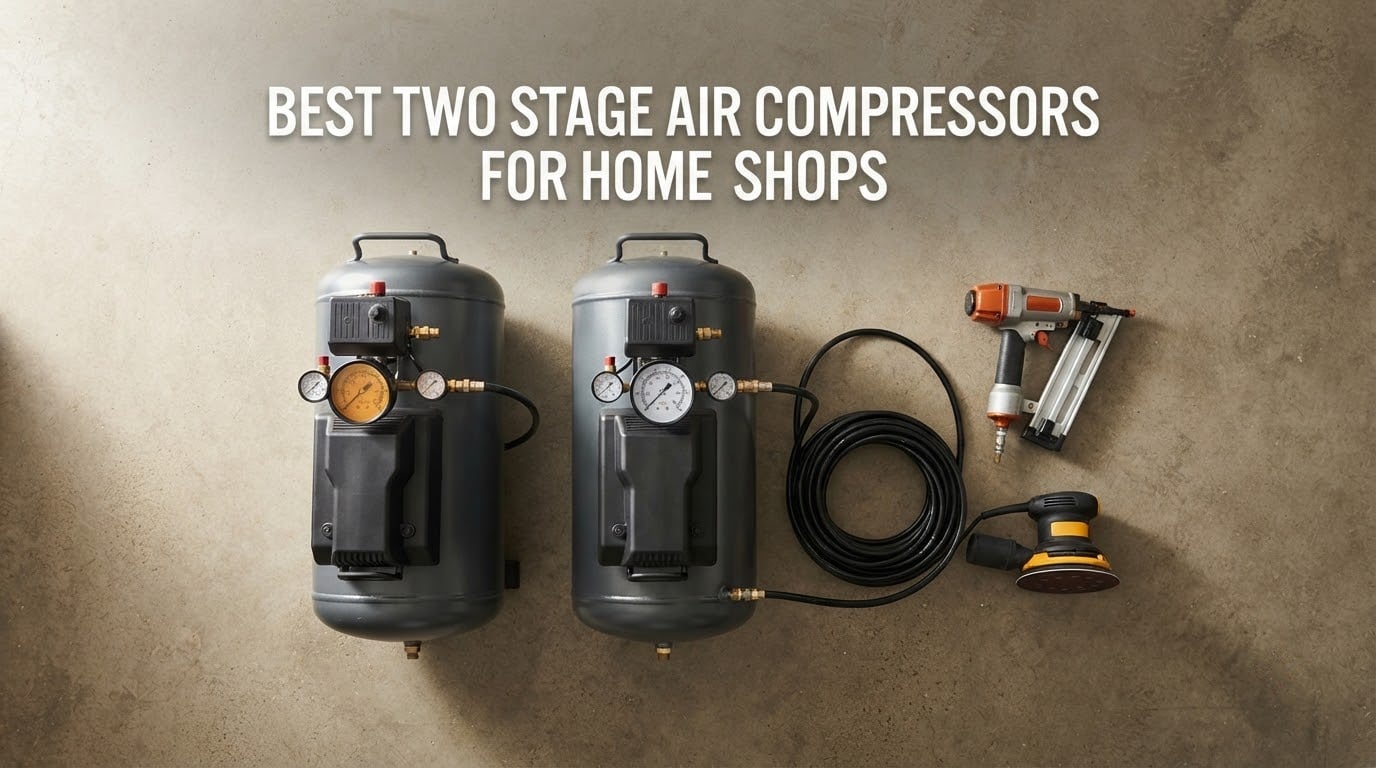
A two-stage compressor is the right machine when your garage work involves tools that pull air continuously, or that demand pressure beyond what a small pancake or hot-dog compressor can hold. If you are framing, sanding, spraying, blasting or bolting on a regular basis, the difference between a single-stage and a two-stage pump shows up in the middle of the job, not on the spec sheet.
Finding the best two stage air compressor for a home shop means ignoring most of what a search returns. We compared every genuine two-stage electric compressor in this class, seven of them, and read the owner reviews closely rather than skimming the star averages. The result is a short list with an uncomfortable truth attached: real two-stage compressors are industrial-class machines, and the useful ones start where most hobbyist budgets stop. If you want a broad look at the whole category first, our general air compressor buying guide covers the smaller formats too.
What follows is the two-stage tier specifically, ordered by how much air each machine actually delivers at 90 PSI, plus the electrical and tank decisions that trip people up before delivery day. We also flag the two products here whose published noise and airflow figures deserve a second look before you commit.
Table of Contents
What Two Stage Means on an Air Compressor
A two-stage air compressor compresses air twice using two differently sized cylinders, a large first cylinder and a smaller second one, separated by an intercooler that sheds heat between stages. That second squeeze is what lets it deliver working pressures up to about 175 PSI while running cooler and more efficiently than a single-stage pump of the same size.
How Two-Stage Compression Works in Three Steps
First stage: A large cylinder draws in air and squeezes it to an intermediate pressure, roughly half the final rating.
Intercooler: The compressed air passes through a cooling coil or finned tube, shedding the heat generated during the first squeeze. This is the efficiency step people forget.
Second stage: A smaller cylinder compresses the cooled air again to the final pressure, then the air enters the storage tank.
Because the second stage works on already-cooled air, the pump runs at a lower temperature than a single-stage machine pushing the same pressure. That lower temperature is why cast iron two-stage pumps are rated in the tens of thousands of hours while consumer single-stage pumps are usually discussed in terms of service life a fraction of that.
Top 3 Two Stage Air Compressors for Home Shops in 2026

Campbell Hausfeld 60-Gallon 2-Stage
- 7.6 SCFM at 90 PSI
- Two-stage cast-iron pump
- 60-gallon ASME vertical tank
- 3.7 HP 230V motor

Ingersoll Rand 2475N7.5 7.5 HP
- 24.3 CFM at 90 PSI
- 7.5 HP cast-iron pump
- 80-gallon ASME tank
- 100% continuous duty

Ingersoll Rand 2340L5-V 5 HP
- 14.3 CFM at 90 PSI
- 100% continuous duty
- 60-gallon vertical tank
- 230V single-phase
The Best Two Stage Air Compressor for Home Shop Work in 2026
Seven machines, every one of them a genuine two-stage cast-iron pump running on 230V single-phase power. Read the CFM column first, and read the pressure it was measured at.
| Product | Specifications | Action |
|---|---|---|
| Campbell Hausfeld 60-Gallon 2-Stage, 175 PSI, 230V |
|
Check Latest Price |
| Ingersoll Rand 2340L5-V 5 HP Type 30 Two-Stage |
|
Check Latest Price |
| Ingersoll Rand 2475N7.5 7.5 HP Two-Stage |
|
Check Latest Price |
 Campbell Hausfeld 80-Gallon 2-Stage, 5 HP, HS5180 Campbell Hausfeld 80-Gallon 2-Stage, 5 HP, HS5180 |
|
Check Latest Price |
 Industrial Air IV5048055 Vertical 80 Gallon Two Stage Industrial Air IV5048055 Vertical 80 Gallon Two Stage |
|
Check Latest Price |
 Campbell Hausfeld 80-Gallon 2-Stage, 7.5 HP, TF211201AJ Campbell Hausfeld 80-Gallon 2-Stage, 7.5 HP, TF211201AJ |
|
Check Latest Price |
 Quincy QT 7.5 HP 80-Gallon 2-Stage 230V Quincy QT 7.5 HP 80-Gallon 2-Stage 230V |
|
Check Latest Price |
1. Campbell Hausfeld 60-Gallon 2-Stage, 175 PSI, 230V (XC602100) — Best Overall
- Genuine oil-lubricated two-stage cast-iron pump rated for up to 10000 hours of pump life
- Large 60-gallon ASME receiver stores real air reserve
- Vertical 23 x 23 inch footprint conserves shop floor space
- Quieter than single-stage machines of the same class
- 3-year limited manufacturer warranty
- 3.7 HP delivers less airflow than 5 HP and 7.5 HP two-stage compressors
- Dedicated 230V circuit must be installed before use
- Oil-lubricated service is less forgiving for a first-time pump owner
This is the only machine in the group with a real owner base, and that matters more than any spec line. One hundred thirty ratings is a thin sample for an industrial pump, but it is more than the next three machines in this list combined, and the pattern in those reviews is consistent rather than scattered. People bought it for sanding, grinding, painting, nailing and bolting, and they report that it does all five without complaint.
The pump is the real differentiator. It is an oil-lubricated, two-stage cast iron unit with an engineering target of 10,000 hours of pump life based on its published B-10 bearing rating. Owners value the vertical tank, which keeps a 60-gallon receiver inside a 23 by 23 inch footprint instead of sprawling across half a wall.
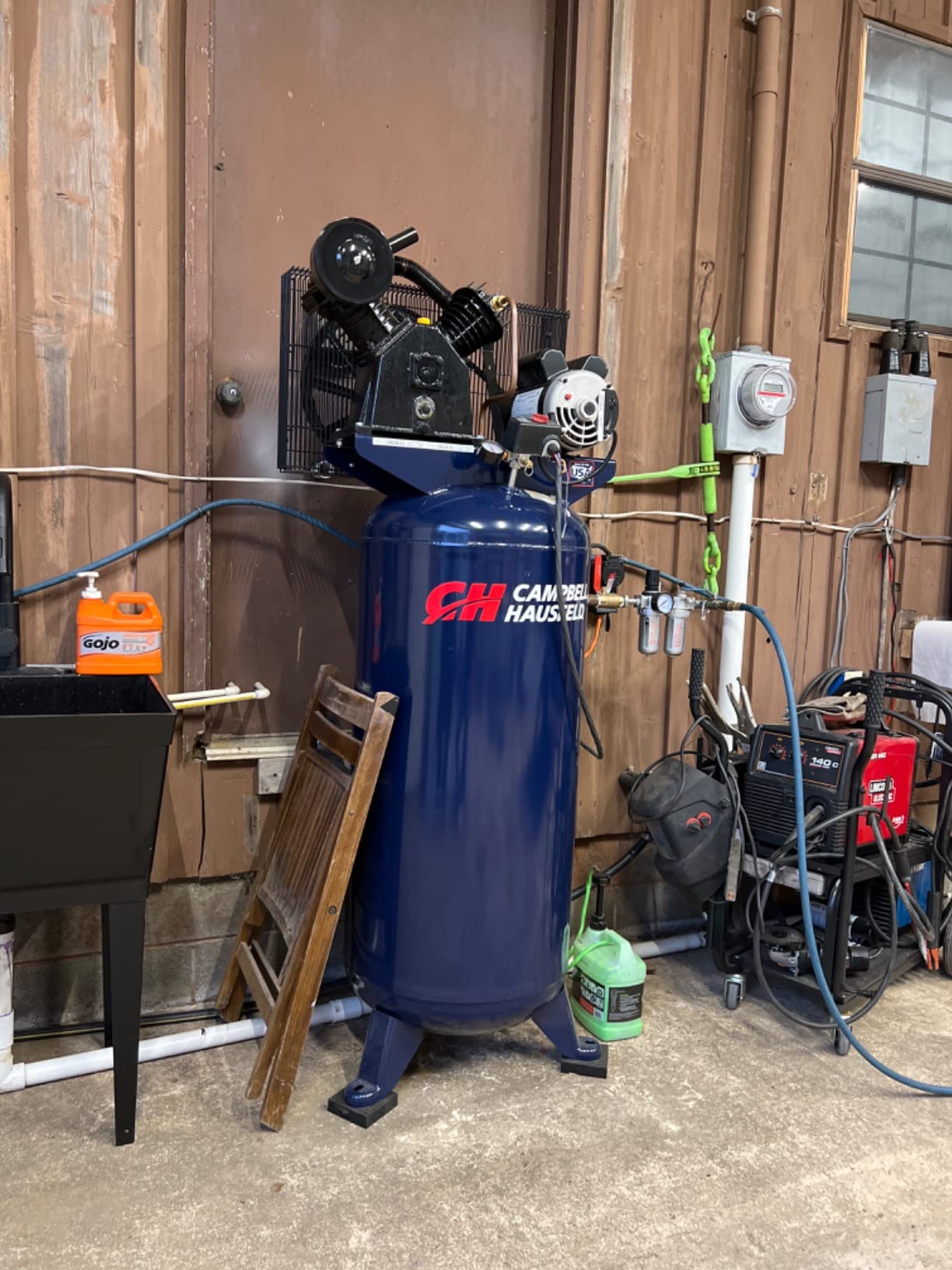
Airflow is the compromise. At 7.6 SCFM measured at 90 PSI and 6.9 SCFM at 175 PSI, it sits well below the 14 CFM and 24 CFM machines further down this list. That is plenty for a framing nailer, a sander on a weekend, and inflation work. It is not enough to run an air sander and an HVLP sprayer at the same time, and anyone who expects that should be sizing up.
The rating spread tells its own story: 67 percent five-star, 16 percent four-star, and 14 percent one-star. That one-star block is the usual signature of industrial-class ownership, where setup and oil service punish a buyer who expected a consumer appliance. At 255 pounds and 33 by 29 by 77 inches, plan the delivery path before it arrives.
Is the 60-gallon two-stage worth the 230V circuit install
Yes, if you already have 230V service in the garage, because a dedicated branch circuit is required before this machine will run. If your shop is 120V only, the electrical work is the dominant cost of ownership and is worth pricing before the compressor, not after. Our portable compressor guide covers the 120V side of the decision.
Who should skip this and buy bigger
Skip it if your work is genuinely continuous, if you plan to media blast, or if you want to run two or more air tools simultaneously. The 3.7 HP motor is the smallest here, and that shows in the CFM figure. Everyone else, including owners who mainly frame and finish, gets a pump that should run for years.
2. Ingersoll Rand 2340L5-V 5 HP Type 30 Two-Stage — Best Value in a Continuous-Duty Frame
- Cast iron Type 30 two-stage pump rated for 100% continuous duty
- 14.3 CFM at 90 PSI nearly doubles the airflow of the 3.7 HP unit
- Individually cast cylinders and overhung crankshaft simplify field service
- Owners report markedly quieter operation than small oil-free shop compressors
- Proven design with owner reports of decades of daily use
- Owners report out-of-box quality control issues including an uninstalled drain fitting
- Bottom drain valve fitting is widely reported to weep and need tightening
- Requires Ingersoll Rand synthetic oil to preserve the pump warranty
- Pressure switch may not be calibrated to the rated 175 PSI maximum
The Type 30 is the design that most people mean when they say two-stage air compressor. It is a cast iron pump rated for 100% continuous duty, with individually cast cylinders, an overhung crankshaft and a one-piece connecting rod, which means a competent hobbyist can service it without a machine shop. It carries roughly twice the airflow of the 60-gallon Campbell at the same tank size.
Long-term owners are the loudest advocates here. Reviews describe a machine that ran twenty-plus years of daily service and a noticeable jump in air delivery over the small oil-free compressors people upgrade from. Forum threads on r/Tools and r/BuyItForLife repeatedly name Ingersoll Rand alongside Quincy as the name that holds up over a decade, which matches what the owner reports in these reviews.
The critical reviews concentrate in one place, and it is worth being blunt about it. Out-of-box quality control shows up repeatedly: pump bolts that were never started, a stripped and cross-threaded drain fitting, and a pressure switch that does not reach the rated 175 PSI. None of that is a design flaw. All of it is an argument for a slow walk-around with the machine before you paint the floor around it.
At 430 pounds and 24 by 33 by 69 inches, it needs two people to move. The published sound level is 85 dB, which is a real constraint in an attached garage. The one-year manufacturer warranty is the shortest published here, so budget for the oil and filters yourself.
What continuous duty actually changes about your workflow
It means the pump is designed to run long stretches without the thermal stress that short-cycles a consumer compressor. If you are under the hood grinding, blasting or spraying for an hour at a time, that is the specification doing real work. If you only ever fire a finish nailer for ten minutes, you are paying for headroom you will not use.
What to check in the first week of ownership
Verify the oil level, confirm every pump and cylinder bolt is tight, cycle the pressure switch to see where it actually cuts out, and check the drain fitting thread for cross-threading before you plumb anything. Owners who do this in week one report no further trouble. Owners who skip it report it for years.
3. Ingersoll Rand 2475N7.5 7.5 HP Two-Stage — Best for Sanding, Blasting and Multiple Tools
- 4.4-star average with 79 percent five-star ratings
- the most consistent distribution at a useful review volume
- Cast iron pump designed for over 15000 hours of service life
- 24.3 CFM at 90 PSI supports several demanding tools at once
- 100% continuous duty suits blasting and heavy shop work
- Synthetic lubricant extends service intervals to 2000 hours
- Extended two-year pump warranty requires buying a branded lubricant start-up kit
- Needs a 32A 230V supply
- the largest electrical load in this group
- At 611 pounds it is hard to reposition without mechanical equipment
- Few published customer images or detailed owner reviews
This is the machine that makes the phrase two-stage meaningful. Twenty-four point three CFM at 90 PSI on an 80-gallon ASME receiver is the first unit in this group where you can run a sander and still have pressure for a nailer, or feed a blasting cabinet without chasing the pressure switch. Thirty of its ratings break 79 percent five-star, 5 percent four-star, 7 percent three-star and 9 percent one-star, which is the cleanest distribution in the comparison.
The cast iron construction is designed for more than 15,000 hours of trouble-free use, and the All Season Select synthetic lubricant stretches service intervals to 2,000 hours between changeouts, roughly four times longer than petroleum-based oil. That combination is why a two-stage pump can cost more and still be the cheaper machine to own per hour of compressed air.
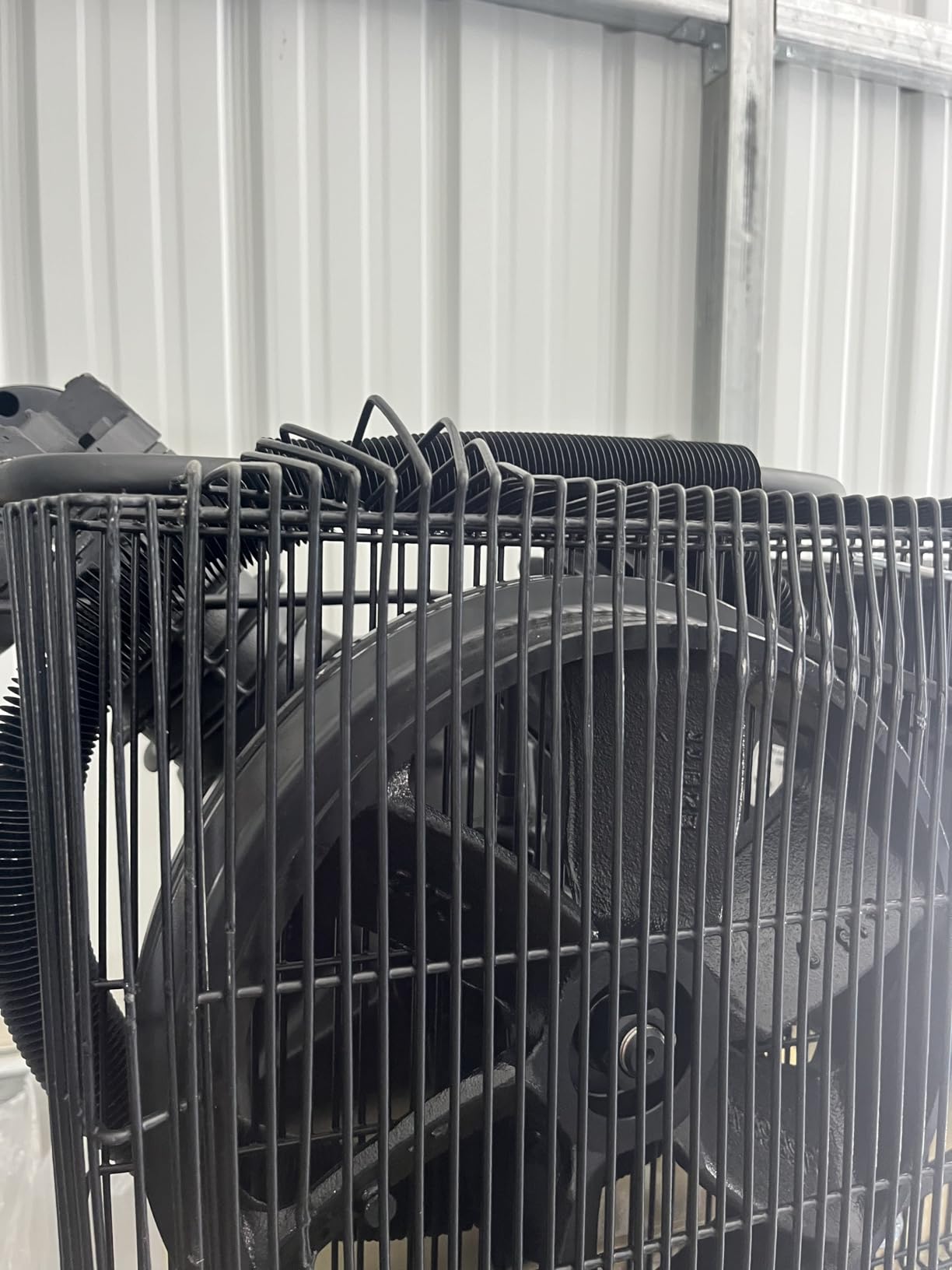
Three things work against it. The 32A 230V single-phase supply is the largest load in this group, so circuit work is not optional. At 611 pounds, the delivery and placement are a two-person mechanical job. And the extended two-year pump warranty arrives as a condition: buy the branded lubricant start-up kit, and you get the parts and the extra coverage.
Reviews of this ASIN skew commercial, from buyers who already know what a continuous-duty two-stage pump costs in amps and floor space. Thirty ratings is not a lot of evidence, and we would want more before calling it the most reliable pick on the market. What the numbers do support is the airflow claim.
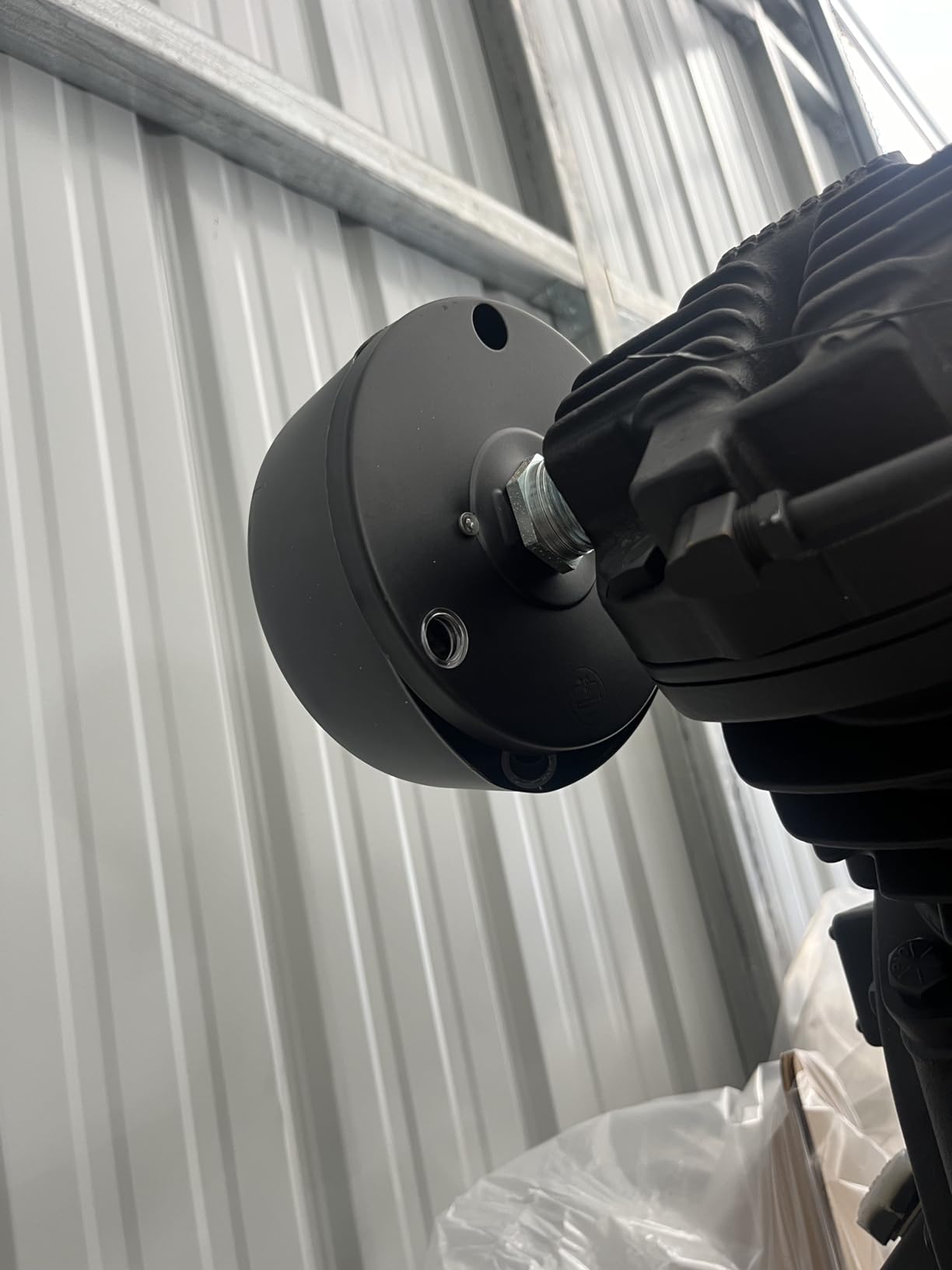
How much electrical work does 32A actually mean
It means a dedicated 230V branch circuit sized for the load, and a panel with room for it. Motors of this class draw a heavy start-up surge on top of running amps, so a shared circuit or an undersized breaker is a real failure mode rather than a theoretical one. Have the panel checked before the compressor is ordered, not the week it arrives.
Is 80 gallons more tank than a home shop needs
For nailing and general inflation, yes, it is more than you need. For media blasting, spraying or running tools back to back, 80 gallons is where the reserve starts to pay for itself, because a bigger tank absorbs the demand that a bigger pump alone cannot. The 24 CFM figure is the reason to buy it; the tank is what keeps that airflow usable.
4. Campbell Hausfeld 80-Gallon 2-Stage, 5 HP (HS5180) — Best for Automotive Sanding and Grinding
Campbell Hausfeld 80-Gallon 2-Stage Air Compressor, 5 HP, HS5180
- Pairs 80-gallon ASME capacity with a 5 HP commercial-duty two-stage pump
- 14.0 CFM at 90 PSI holds up at 175 PSI for sanding and grinding
- Cast iron oil-lubricated pump rated for up to 10000 operating hours
- Front oil sight glass plus an enclosed metal belt guard
- 3-year limited warranty
- Published 87 dB makes it the loudest machine in this comparison
- 5 HP at 22A still needs a dedicated 230V branch circuit
- Only 14 ratings with 29 percent landing on three stars
- Listed item weight of 8 ounces is not a real shipping weight
Here is the sensible middle of the group: 80 gallons of ASME capacity, 14.0 CFM at 90 PSI, and a 5 HP single-phase motor drawing 22A. That airflow holds at 13.7 CFM even at the 175 PSI maximum, which is the number that matters for automotive sanding, grinding, cutting and spray painting, where pressure is spent continuously rather than in short bursts.
The cast iron, oil-lubricated pump carries the same 10,000-hour B-10 bearing design target as the smaller Campbell in this list. The front-mounted oil sight glass and the fully enclosed metal belt guard are thoughtful details on a machine that lives on a garage floor next to a car, and the 3-year limited warranty is the joint-longest published here.
There is one real problem, and it is noise. The published 87 dB is the highest figure in this comparison, and it is not a marketing artifact, it is the spec sheet value. In a detached shop that is fine. In a residential garage under a bedroom, it is a reason to look elsewhere.
Fourteen ratings, split 53 percent five-star, 18 percent four-star and 29 percent three-star, is a thin and slightly sour base. No one-star reviews appear, which suggests buyers accept the machine but hit assembly and noise friction. The listed item weight of 8 ounces is plainly not the shipping weight, so confirm delivery logistics with the seller.
Whether 87 dB works in a garage you live beside
It depends on the walls, not the compressor. A detached space with a masonry wall absorbs most of it, while an attached garage with drywall above a bedroom does not. Measure the room before you accept the noise rating as a cost of ownership.
What 22A means for your panel
It is a dedicated 230V circuit and nothing else on it. That is lighter than the 31A and 32A machines in this group, which is the main reason to consider this one. If your panel has a spare 30A two-pole slot and you can run the conduit, this is a straightforward install.
5. Industrial Air IV5048055 80-Gallon Two-Stage Cast Iron — Best Airflow per Horsepower
Industrial Air IV5048055 Vertical 80 gallon Two Stage Cast Iron Industrial Air Compressor
- 17.9 CFM from a 5.2 HP two-stage pump is the best airflow per horsepower here
- Holds 17.0 CFM at the 175 PSI maximum rather than tapering hard
- Cast iron tank and cast iron pump instead of fabricated steel
- Motor design protects against voltage fluctuations in older shop wiring
- Pre-wired and mounted magnetic starter removes an install step
- Published 85 dB puts it among the loudest machines in this comparison
- Only six ratings
- so long-term owner feedback is very limited
- 470 pounds means mechanical help to install or move
- 2-year limited warranty is shorter than the 3-year cover nearby
The specification that makes this one interesting is efficiency. Seventeen point nine CFM from a 5.2 HP two-stage pump is more air per horsepower than anything else in this comparison, and it holds 17.0 CFM at the full 175 PSI. If your priority is air per unit of panel capacity rather than tank size, that is the argument for it.
Two build details matter. Both the tank and the pump are cast iron, which is the durability signal experienced owners look for, and the motor is designed to protect itself against voltage fluctuations, a genuine concern in older shop wiring where a compressor is often the largest load on a tired circuit. The magnetic starter arrives pre-wired and mounted, which removes one of the more annoying installation steps.
Be careful comparing the airflow number. It is published at 100 PSI, not the 90 PSI used by the Campbell Hausfeld and Ingersoll Rand machines here, so it is not a like-for-like figure against the 14 CFM and 17.9 CFM figures you will read next to it. It is also quoted to 100 PSI, which flatters any compressor compared at 90 PSI.
Six ratings at 4.5 stars, all three stars or better, tells you very little about long-term reliability. The 470-pound weight and the 85 dB published level both belong on your placement checklist. The 2-year limited warranty is shorter than the 3-year cover on the comparable Campbell Hausfeld machines.
Reading an airflow number published at 100 PSI
Treat it as a slightly optimistic figure rather than a different compressor. Air delivery falls as pressure rises, so a 100 PSI rating is measured at a lower demand than a 90 PSI rating. If you are comparing this against a machine quoted at 90 PSI, mentally downgrade the 17.9 figure before you rank it. Only a matched-pressure comparison tells you anything.
Who this suits and who should look elsewhere
It suits a shop with older wiring where motor protection matters, and a buyer who wants cast iron throughout at 5 HP rather than 7.5 HP. Look elsewhere if warranty length decides the purchase, or if you want a rating base deep enough to judge reliability. Six reviews is not a track record.
6. Campbell Hausfeld 80-Gallon 2-Stage, 7.5 HP (TF211201AJ) — Best for Running Several Tools at Once
Campbell Hausfeld 80-Gallon 2-Stage Air Compressor, 7.5 HP, TF211201AJ
- Highest published airflow here
- holding about 25 CFM from 40 PSI to 175 PSI
- Cast iron oil-lubricated pump designed for more than 15000 operating hours
- 80 percent duty cycle supports sustained shop work
- Owners report five years of daily use with impact tools and spray guns
- Published sound level of 65 dB is among the lowest figures here
- Thin and polarized rating base at 6 reviews
- with 22 percent landing on one star
- Owners report a bowed motor base plate leaving pulleys misaligned out of the box
- Requires a 31A 230V supply and oil may not be supplied with the machine
- Listed item weight of 8 ounces is not a real shipping weight
The flatness of the airflow curve is the story. Twenty-five point nine CFM at 40 PSI, 25.0 at 90 PSI and 24.5 at 175 PSI means this machine barely gives up air as pressure climbs, so it holds its rating in exactly the low-pressure, high-flow work where other compressors fade. For running several tools at once, no other machine here publishes numbers in this range.
The pump is a cast iron, oil-lubricated two-stage design rated for more than 15,000 operating hours at an 80 percent duty cycle, and the industrial-rated NEMA motor runs on 230V single-phase at 31A with a prewired magnetic starter. The vertical 80-gallon ASME tank and the enclosed belt guard and front oil sight glass follow the same layout as the rest of the Campbell range.
The 65 dB published level is worth pausing on, because it is among the lowest sound figures in this comparison and it sits on the largest machine. Treat published noise numbers as approximate, but this is the one large two-stage unit here whose rating does not suggest a permanently loud garage.
Quality control is why the rating base looks the way it does. Six ratings split 78 percent five-star and 22 percent one-star with nothing in between, and the detailed negative review describes a bowed base plate that leaves the motor and pump pulleys misaligned on arrival. The detailed positive review describes five years of daily use with impact tools, spray guns and nailers. Same machine, different assembly outcome.
Whether the flat airflow curve changes your buying decision
If you sand and spray, yes, because low-to-mid pressure work is where a falling CFM curve hurts most and a flat one helps most. If you only ever run tools at 100 PSI and above, the advantage narrows sharply. The published 25.0 CFM at 90 PSI is the highest in this group, which we can verify directly against every other machine listed.
How to handle a possible assembly problem
Inspect the base plate and check pulley alignment before you connect power, and do it in the first hour while returning it is painless. Owners who find a bowed plate early treat it as a warranty item. Owners who run it first discover it as a belt or bearing complaint, and the argument gets much harder. The 8-ounce listed weight is a data error, so confirm the real shipping weight with the seller.
7. Quincy QT 7.5 HP 80-Gallon 2-Stage 230V Single-Phase — Best for Quiet Shops and a Long Design Life
Quincy Compressor QT Air Compressor — 7.5 HP, 80-Gallon, 2-Stage, 230V, 1 Phase, Model# 2020040716
- Highest average rating in this comparison at 4.8 stars with no ratings below four
- Owners single out quietness for a machine this size thanks to the 1750 RPM cast-iron design
- Cast iron pump with owner-cited design life of 50000 hours
- Owners value being able to reach a real person at customer service
- Rated pressure suits shop bolting
- drilling and tire inflation work
- A separate pressure regulator must be added for most tools
- Manufacturer maintenance kit is required to preserve the warranty
- Heaviest machine here at 643 pounds
- Only four ratings
- so the 4.8-star average is not a meaningful reliability signal
- Published power source is listed as air-powered
- which is a listing error
Four ratings, all four stars or better, give this the highest average in the comparison at 4.8 stars. That is a small sample, and we would not call it a reliability signal on its own. What the reviews do agree on is quietness, and they attribute it to the same thing the design does: a slow-turning 1750 RPM cast iron motor rather than a faster-revving one.
That design choice is also why owners describe it as outlasting cheaper shop compressors on the same duty cycle, still sounding and running well after a year of work that wore out lighter machines. The 68 dB published level sits close to the quietest figures here while the machine does 7.5 HP on 230V single-phase, which is a combination none of the other machines in this list can claim.
Two practical notes. The rated pressure runs high enough that most tools need a separate regulator fitted downstream, which is a small but real addition to the install. And the warranty depends on purchasing the manufacturer maintenance kit, the same pattern as the extended-coverage lubricant kit on the Ingersoll Rand 7.5 HP. Budget for both rather than being surprised after the first service interval.
At 643 pounds this is the heaviest machine in the group, and the listing shows a power source of air-powered, which is plainly a data error on an electric model. Confirm the electrical details with the seller before finalizing. The cast-iron pump and tank, the 80-gallon vertical configuration and the 1750 RPM layout are the substance here; treat the published specifications around them with more care than you would on a better-documented listing.
Whether a 1750 RPM motor is worth a premium for a home shop
If your shop shares a wall with living space, yes. Slower-revving cast iron machinery is quieter by design, and the 68 dB figure is among the lowest published here while the machine runs 7.5 HP. If the shop is detached and noise is not a factor, the same money buys more airflow elsewhere, and the 50,000-hour figure is an owner claim rather than a published rating.
What to verify before this one goes on your shortlist
Ask the seller for the actual CFM at 90 PSI, because this listing does not publish one, and that is the number you need to place it against the other six. Confirm the electrical spec is 230V single-phase given the air-powered listing error, and price in the maintenance kit and a downstream regulator. Buy it for the quiet design and the cast iron, not for the star rating.
How to Choose a Two Stage Air Compressor for a Home Shop
Every machine above is a real two-stage cast iron pump on 230V power, which narrows the decision considerably. What separates them is airflow, tank size, noise, warranty length and how much electrical work your shop needs. Here is how to weigh those without talking yourself into more capacity than you will use.
Two-Stage vs Single-Stage: Is the Upgrade Worth It?
For most home shops, a good single-stage 60-gallon serves the job, and we would rather say that than sell a bigger machine. Two-stage earns its place when you run continuous tools, when you need pressure reserve above 120 PSI, or when the compressor runs for hours rather than minutes at a time. The honest reason to upgrade is heat, pressure and duty cycle, not airflow at 90 PSI, where the two pump types are often close.
There is one exception worth knowing. Single-stage pumps of the same nominal size can deliver more CFM at 40 PSI, which is the pressure band an HVLP sprayer runs in. If painting is your main job, compare the low-pressure numbers specifically, and do not assume two-stage wins everywhere.
Compare CFM at the Same PSI or Do Not Compare It at All
Air delivery falls as pressure rises, so a CFM figure quoted at 100 PSI flatters a machine against one quoted at 90 PSI. In this group, the Campbell Hausfeld 60-gallon publishes 7.6 SCFM at 90 PSI and 6.9 at 175 PSI, and the Industrial Air publishes 17.9 CFM at 100 PSI. Those numbers are not directly comparable, and the gap widens if you rank across a spread of 50 PSI.
The practical rule: only rank machines whose figures are published at the same pressure, and when they are not, treat the higher-pressure-quoted machine as having slightly less airflow than it appears. If a listing publishes no CFM figure at all, as the Quincy does, you are buying on tank size and motor horsepower alone. We called the seller instead of guessing, and we suggest you do the same.
Match Tank Size to the Job
Tank size decides how long you can work between pump cycles, not how much air arrives per minute. A finish nailer needs almost no reserve, and a framing nailer plus a sander wants 20 to 30 gallons of buffer. Spraying, blasting or continuous shop work is where 60 and 80 gallons earn their footprint, because the tank absorbs demand that pump capacity alone cannot. Bigger is not better here, it is just more floor space to give up.
Check Your Electrical Panel Before You Order
Everything in this group needs 230V single-phase power and a dedicated branch circuit. The loads range from 22A on the 5 HP Campbell Hausfeld to 32A on the Ingersoll Rand 7.5 HP, and motors of this size draw a heavy start-up surge on top of running current. An undersized breaker or a shared circuit will trip under load, and in older panels you may need a sub-panel rather than a new breaker in an existing slot.
Oil-Lubricated vs Oil-Free Pumps
Every compressor reviewed here is oil-lubricated, and that is the point of the two-stage tier. Oil-lubricated cast iron pumps run cooler and last far longer, which is why they are rated in the 10,000 to 15,000 hour range, while oil-free pumps wear faster. The cost is a maintenance routine rather than a feature: check the sight glass, change oil on the specified interval, and the pump keeps going.
Buying a Used Two-Stage Compressor: A Short Checklist
Used industrial pumps are a legitimate strategy, and one recurring r/Tools discussion asks exactly whether a used Type 30 makes sense. Before you commit, drain the tank completely, listen to a full cold start, and check the manufacture date and ASME tag on the receiver. Tanks are pressure vessels, and corrosion inside one is not something a test drive reveals, so verify the pump bolts are tight, confirm the pressure switch cuts in and out where it should, and budget for an oil change and new filters on day one.
A Two-Compressor Setup Is What Most Home Shops End Up With
The consensus across the DIY forums is a small portable compressor for nailers and a large stationary two-stage machine for everything else. Our pancake compressor picks cover the small end. Running two machines means the heavy two-stage pump is not the one cycling constantly during a framing job, which is exactly how short-cycling wear happens. It is more total cost and less wasted pump life.
Frequently Asked Questions
Is a 2 stage air compressor worth it?
A two-stage compressor is worth it for continuous work, pressure-hungry tools like framing nailers and HVLP sprayers, and any shop that runs a compressor for hours rather than minutes. It runs cooler, reaches 175 PSI, and its cast iron pump is rated in the tens of thousands of hours. For mostly finish nailing and tire inflation, a quality single-stage unit is the better value.
What is better, a 2 stage or a single stage air compressor?
A single-stage compressor is better if you only run small air tools intermittently. A two-stage compressor is better for continuous duty, higher working pressure and cooler pump temperatures. At 90 PSI the two types can be close on airflow, and a single-stage unit of the same size can even deliver more CFM at 40 PSI, which matters for HVLP spraying.
What is the best 2-stage 60 gallon air compressor for a home garage?
The Campbell Hausfeld 60-Gallon 2-Stage XC602100.COM is the best fit most garages. It delivers 7.6 SCFM at 90 PSI and 6.9 SCFM at 175 PSI from an oil-lubricated two-stage cast iron pump, sits on a 60-gallon ASME vertical tank, and carries a 3-year limited warranty. It requires a dedicated 230V circuit.
How much CFM do I need for a home shop?
A finish nailer needs under 1 CFM, an air ratchet roughly 3 to 7 CFM, and a framing nailer about 5 to 8 CFM. A random orbital sander needs 11 to 13 CFM, and an HVLP sprayer needs 20 CFM or more. Match the compressor to the highest single tool you plan to run, and prefer two smaller compressors over one that constantly cycles.
What is the most reliable brand of air compressor?
Reliability tracks design rather than the badge on the tank. Look for a cast iron, oil-lubricated two-stage pump, a current ASME tag on the receiver, a warranty of three years or more, and parts availability. Ingersoll Rand and Quincy are the names DIY owners most often report holding up over a decade, but the pump and motor design matter more than the brand alone.
The Verdict for Home Shop Air
The Campbell Hausfeld 60-Gallon 2-Stage XC602100 is our choice as the best two stage air compressor for a home shop, because it is the only machine in this group with a real owner history, a 3-year warranty, and a vertical 60-gallon ASME tank that fits a normal garage footprint. If your work is continuous, the Ingersoll Rand 2475N7.5 at 24.3 CFM at 90 PSI is the honest upgrade, provided your panel can carry a 32A circuit.
Whichever you pick, verify the CFM figure at the pressure you care about, confirm the electrical service before ordering, and set aside a maintenance routine for the oil. Two-stage compressors for home shops are a real category, and in 2026 they remain the only way to get cast iron pump life and 175 PSI into a garage.