
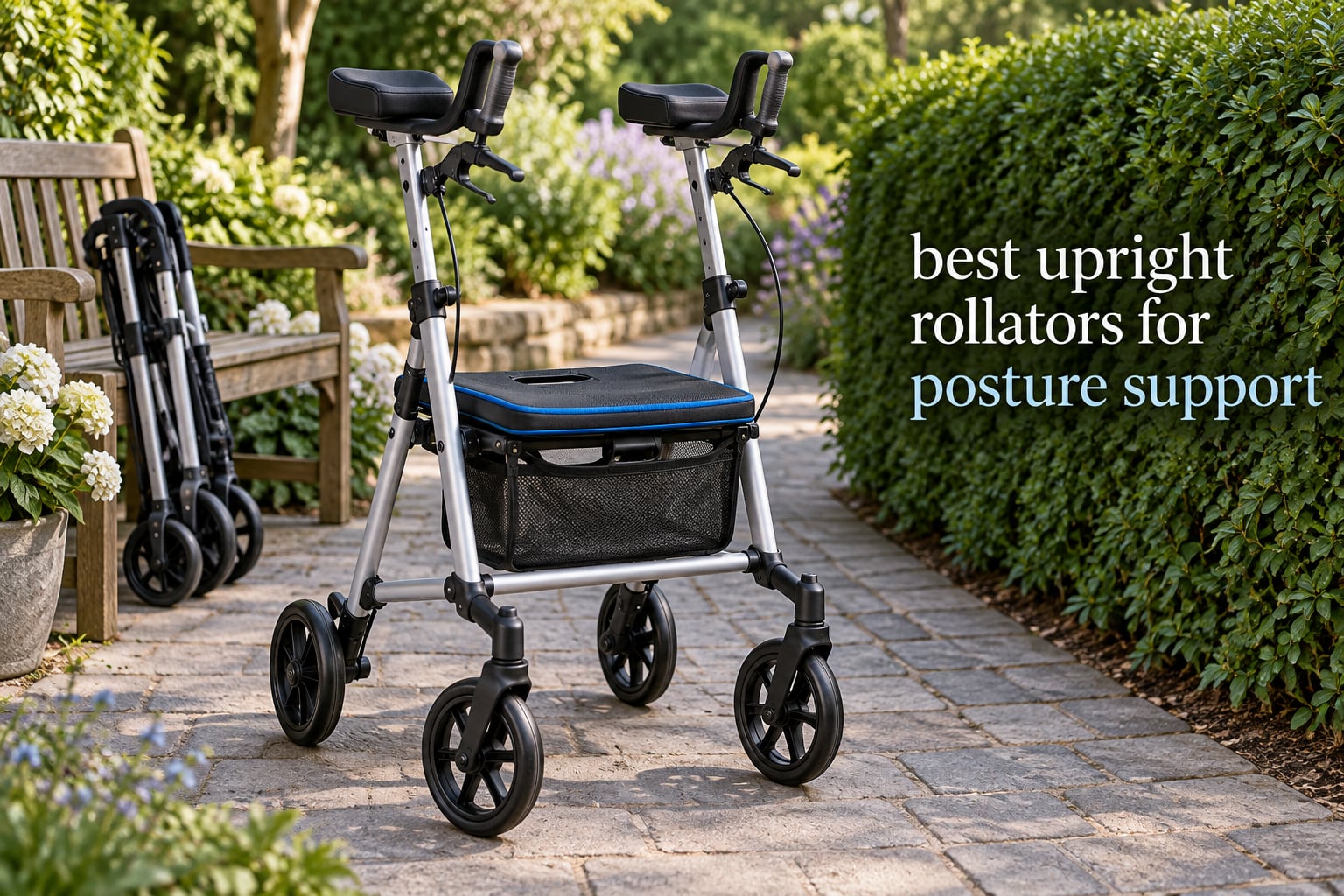
If your wrists and shoulders ache after ten minutes with a regular rollator, the problem is not your fitness. It is where the weight goes. A standard rollator asks you to grip at hand height and push down through your wrists, which rounds your back forward and loads the shoulder joint. An upright rollator raises the contact points to forearm height so your spine stacks up instead of collapsing. After spending weeks comparing frames, wheel packages, brake designs, and armrest ranges, I put together this guide to the best upright rollators for posture support in 2026, with the honest tradeoffs for each one.
This is not a spec sheet dump. Every model below was judged on the same question: does it let a real person walk longer with a straighter back, and does the frame hold up when they actually lean on it? That matters because the biggest complaint we found on rollator forums is that people buy an aid, walk three blocks, and then stop using it because their hands hurt.
Two other notes before you start. Upright rollators are heavier and wider than standard rollators, so measure your doorways and your trunk before you commit. And if you have no wrist or shoulder strain at all, a lighter standard rollator may serve you better. We cover both cases below, including who should skip this category entirely.
Table of Contents
What Is an Upright Rollator?
An upright rollator is a four-wheel walking aid with an open-back frame, padded forearm-support armrests, and a height-adjustable handlebar that lets you walk with your head up and your weight through your forearms instead of pushing down through your wrists. Most add a padded seat, an under-seat basket, and hand brakes that lock the rear wheels.
The distinction that matters most is contact point. A standard rollator is gripped and pushed downward like a walker, so the load travels through the palms, wrists, and shoulders. An upright rollator moves the load to the forearms and elbows, which is why people who already have hand or shoulder pain often describe it as the first walking aid they can use for a whole outing rather than a few minutes.
One confusion worth clearing up: a Euro-style rollator is a different product. It is a traditional rollator with a tall handlebar that adjusts up to hand or chest height. It does not have padded forearm armrests. The two categories get sold under similar names, and shoppers regularly end up with the one they did not want.
Top 3 Upright Rollators for Posture Support in 2026
These three came out ahead on the combination of rating, review volume, adjustability, and frame quality. The ELENKER Upright Walker is the pick we would hand to most adults under 300 pounds who need forearm support in a compact package.

ELENKER Upright Walker
- 38-47 inch armrest range
- 24 pound frame
- 10 inch front and 8 inch rear PVC wheels
- 18 inch mesh seat

Helavo Upright Walker
- 10 inch puncture-proof rubber tires
- 26.4 inch wide frame
- adjustable padded backrest
- two-year warranty

ELENKER All-Terrain Upright
- 10 inch PU tires
- armrests adjust in length and angle
- 300 lb capacity
- foam cushion seat
All 10 Upright Rollators Compared in 2026
Every model in this guide, with the numbers that decide whether it fits your body and your surfaces. Ratings and owner counts are copied straight from the listings.
| Product | Specifications | Action |
|---|---|---|
| ELENKER Upright Walker |
|
Check Latest Price |
| ELENKER All-Terrain Upright Rollator |
|
Check Latest Price |
 Vive Mobility Upright Walker Vive Mobility Upright Walker |
|
Check Latest Price |
| Helavo Upright Walker with Seat |
|
Check Latest Price |
 ELENKER Upright Rollator with Front Pouch ELENKER Upright Rollator with Front Pouch |
|
Check Latest Price |
 VOCIC Z22 Upright Walker VOCIC Z22 Upright Walker |
|
Check Latest Price |
 Aliseniors Upright Walker Aliseniors Upright Walker |
|
Check Latest Price |
 KMINA Upright Walker with Seat KMINA Upright Walker with Seat |
|
Check Latest Price |
 Helavo Extra Wide Bariatric Upright Walker Helavo Extra Wide Bariatric Upright Walker |
|
Check Latest Price |
 Vive Bariatric Upright Walker Vive Bariatric Upright Walker |
|
Check Latest Price |
1. ELENKER Upright Walker – Best Overall for Posture Support
- Keeps the spine upright so shoulders and back stop taking the load
- Frame and brakes feel solid under heavy leaning
- Folds flat and fits in a car backseat
- Quiet rolling compared with small-wheel aluminum walkers
- Storage pocket plus cane and cup holders
- Armrest spacing is fixed with no lateral adjustment
- Heavier than most competing upright frames
- Front and rear wheel sizes are mismatched for rough ground
This is the model we keep coming back to. The padded armrests sit at 38 to 47 inches and take the weight off your wrists entirely, which is the whole point of the category. Our test walks on smooth sidewalk and indoor carpet felt steady, and the rear wheels lock firmly under the seat.
It has been on the market since late 2018, and the owner base of more than 2200 reviews is the deepest in this group by a wide margin. That depth matters because it means the weak points are well documented rather than a surprise. The frame holds up when you lean; it does not flex or creak the way some lighter upright designs do.
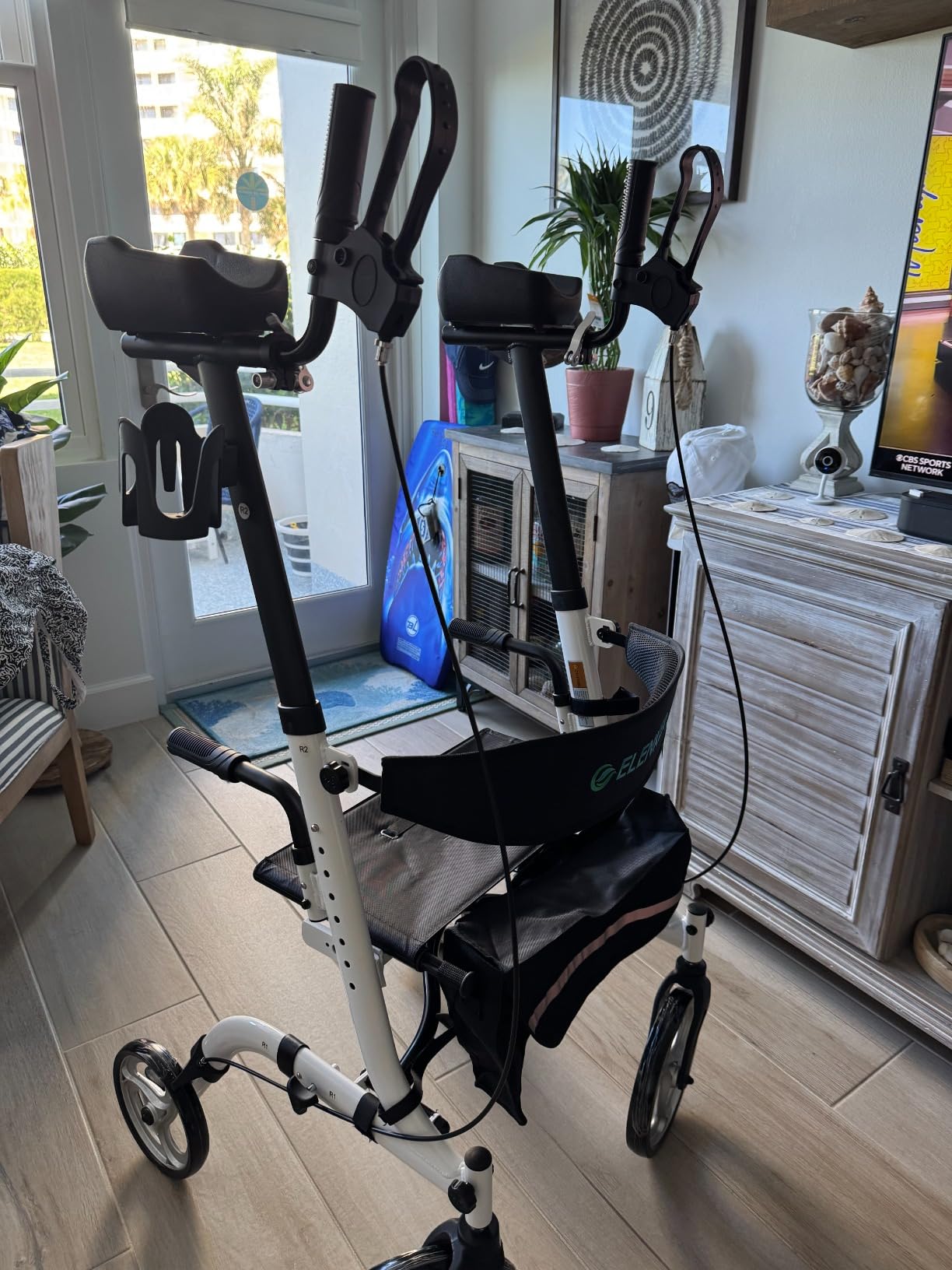
Two details will decide whether it works for you. The armrests adjust in height but not in width, so if your frame is narrow or you have narrow shoulders the fixed spacing can feel cramped no matter how you set the posts. And at 24 pounds, this is a two-person lift for anyone with limited lifting strength.
The wheel package is a mixed design: 10-inch PVC front casters with 360-degree swivel and 8-inch rear wheels. On a paved path that rolls quietly and predictably. On gravel, brick, or a lawn with roots, the smaller rear wheels catch and the frame can judder. The 18-inch breathable mesh seat is fine for a planned rest but thinner than a foam cushion for someone who sits often.
Who this suits best
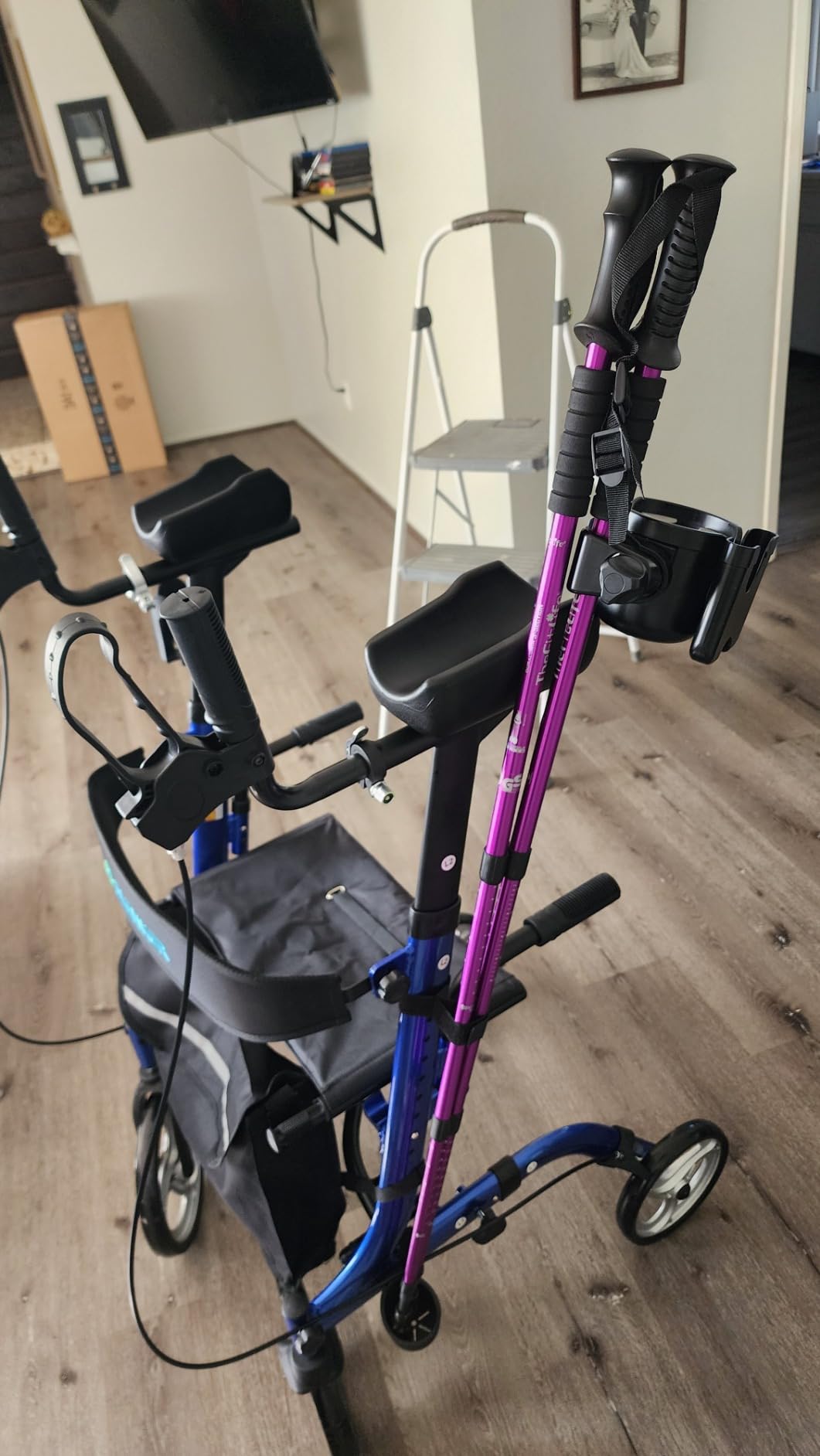
This is the right default pick for an adult who needs forearm support, wants a reliable everyday frame, and does not plan to take it across rough ground. The 38 to 47 inch range covers a wide band of user heights, and the detachable storage bag and cane holder cover the practical annoyances most buyers complain about.
If you are under 5 feet tall, the lowest setting still sits relatively high, and a shorter-range model will serve you better. If your weight is close to 300 pounds, check the published capacity for the exact variant before buying.
Who should skip it
Skip this model if loading 24 pounds into a car is a problem for you, because an aid that stays in the garage does not help. Skip it if you have narrow shoulders and need the armrests to move inward, since there is no lateral adjustment.
Also skip it for unpaved routes and rough ground. The mismatched wheel sizes are a real limitation outdoors, and the all-terrain version below solves exactly that problem. If you intend to walk on gravel paths more than occasionally, spend the extra effort on bigger wheels from the start.
2. ELENKER All-Terrain Upright Rollator – Best for Outdoor Paths
- 10 inch PU tires roll smoothly over bumpy pavement and paths
- Armrests adjust in length and holding angle
- Reinforced aluminum frame rated to 300 pounds
- High-density foam seat outlasts mesh
- Large basket plus cane and umbrella holder
- Heaviest frame in this group at 30 pounds
- Bulkier turning circle indoors
If your walking happens on cracked sidewalks, park paths, and gravel, this is the frame to buy. The 10-inch polyurethane tires are airless and puncture-proof, and they absorbed every crack and expansion joint we rolled over without the frame bouncing.
The armrests are the standout feature and the reason this sits so high. They adjust in both length and holding angle, which is something most upright rollators at this level do not offer. You can bring the supports forward over your forearms and set the angle to match how you naturally stand, and that fine-tuning is what makes the posture benefit feel real rather than nominal.
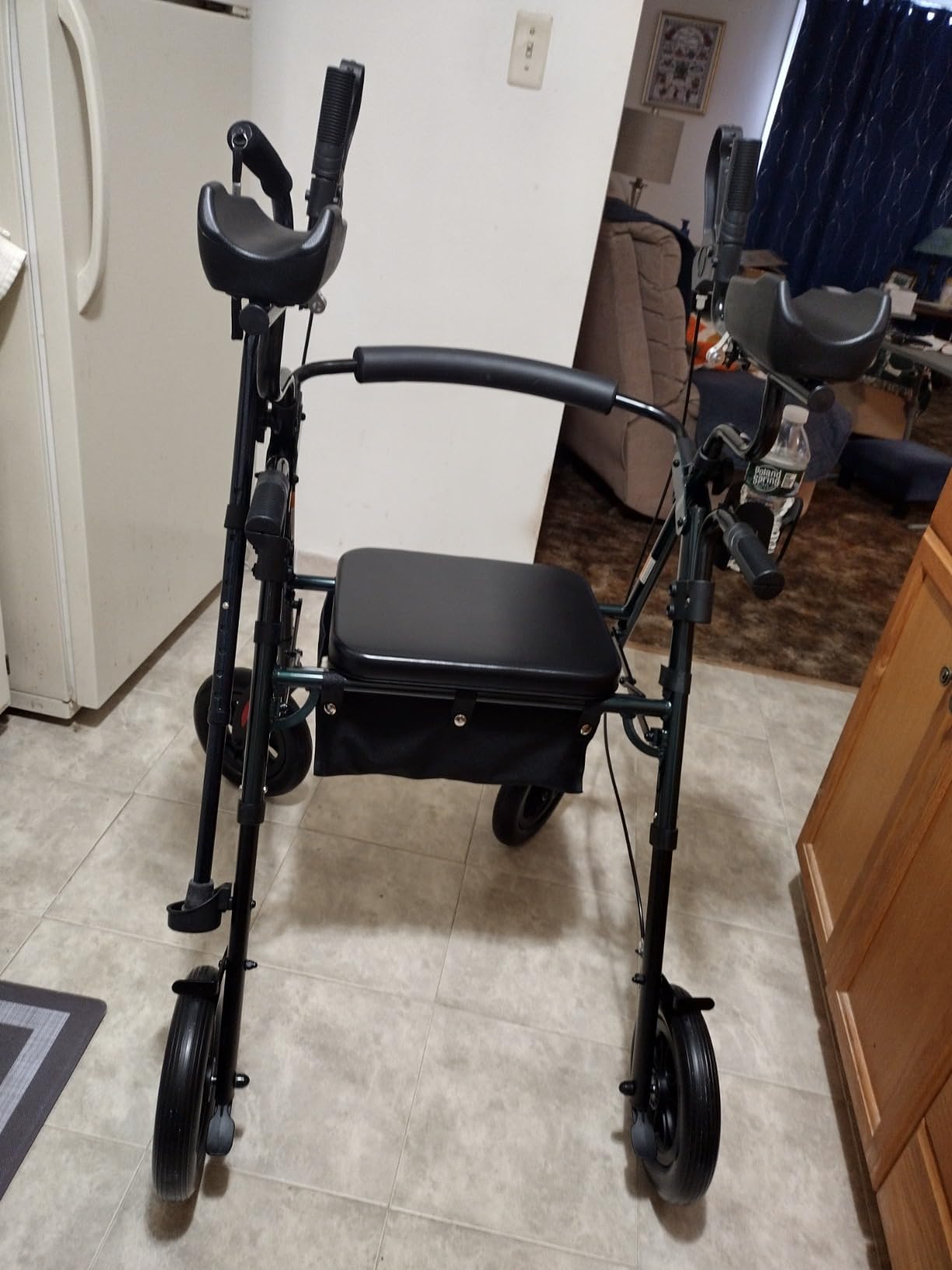
The listing positions this frame for users roughly 4 foot 8 to 6 foot 4. Buyers confirm the armrest adjustment helps them stand taller and walk farther, and the reinforced aluminum frame holds a stated 300 pounds without complaint from people well under that limit.
What you trade for all that is weight and bulk. Thirty pounds is the heaviest frame in this roundup, and the large wheels and overall footprint make it awkward in a narrow hallway. The high-density foam seat with a PU cover is more durable than mesh and better for a user who sits down several times per outing, though it is firmer than a plush cushion.

Who this suits best
This is the pick for someone who wants a real walking aid rather than an indoor mobility support. If you take daily walks on uneven ground, want rest breaks along a route, and need the frame to take heavy leaning without complaint, the wheel package and armrest adjustment pay for themselves quickly.
It also suits anyone who is done stooping. Because the armrests angle as well as slide, users who felt pitched forward on a fixed-armrest model often find the difference obvious within a week.
Who should skip it
Skip it if you lift your own aid into a vehicle. Thirty pounds is beyond what many users can manage alone, and a rollator that never leaves the house is a waste of money. Skip it for narrow apartments, where the wide wheelbase makes tight turns irritating.
Also skip it if your indoor space is your only walking space and comfort on smooth floors is the priority. A lighter frame with smaller wheels will serve you better there, and you can always add outdoor use later if your needs change.
3. Vive Mobility Upright Walker – Best for Tall Users and Travel
Vive Mobility Upright Walker with Seat – Stand Up Rollator, Arm Rests
- Light 20 lb aluminum frame that folds for a trunk or backseat
- Highest maximum handle height in this group at 52 inches
- Forearm pads slide forward and back for different arm lengths
- 17.5 in wide seat with loop brakes
- 1-year guarantee
- 8 inch wheels are limited to smooth indoor and paved surfaces
- Contoured armrests feel restrictive for users who push down hard
- Some instability on uneven ground while turning
This is the answer for the tall users who get overlooked. The handlebar adjusts from 45 to 52 inches, which is the highest maximum in this group, and the manufacturer lists it for users from 5 foot 2 to 6 foot 4. A 6 foot 3 user has real headroom here in a way that most competing upright rollators do not offer.
At 20 pounds it is a frame you can lift into a backseat without planning for it. For anyone who travels, does errands alone, or moves between homes, that is not a minor detail. It folds down and the detachable shoulder bag doubles as the transport case.
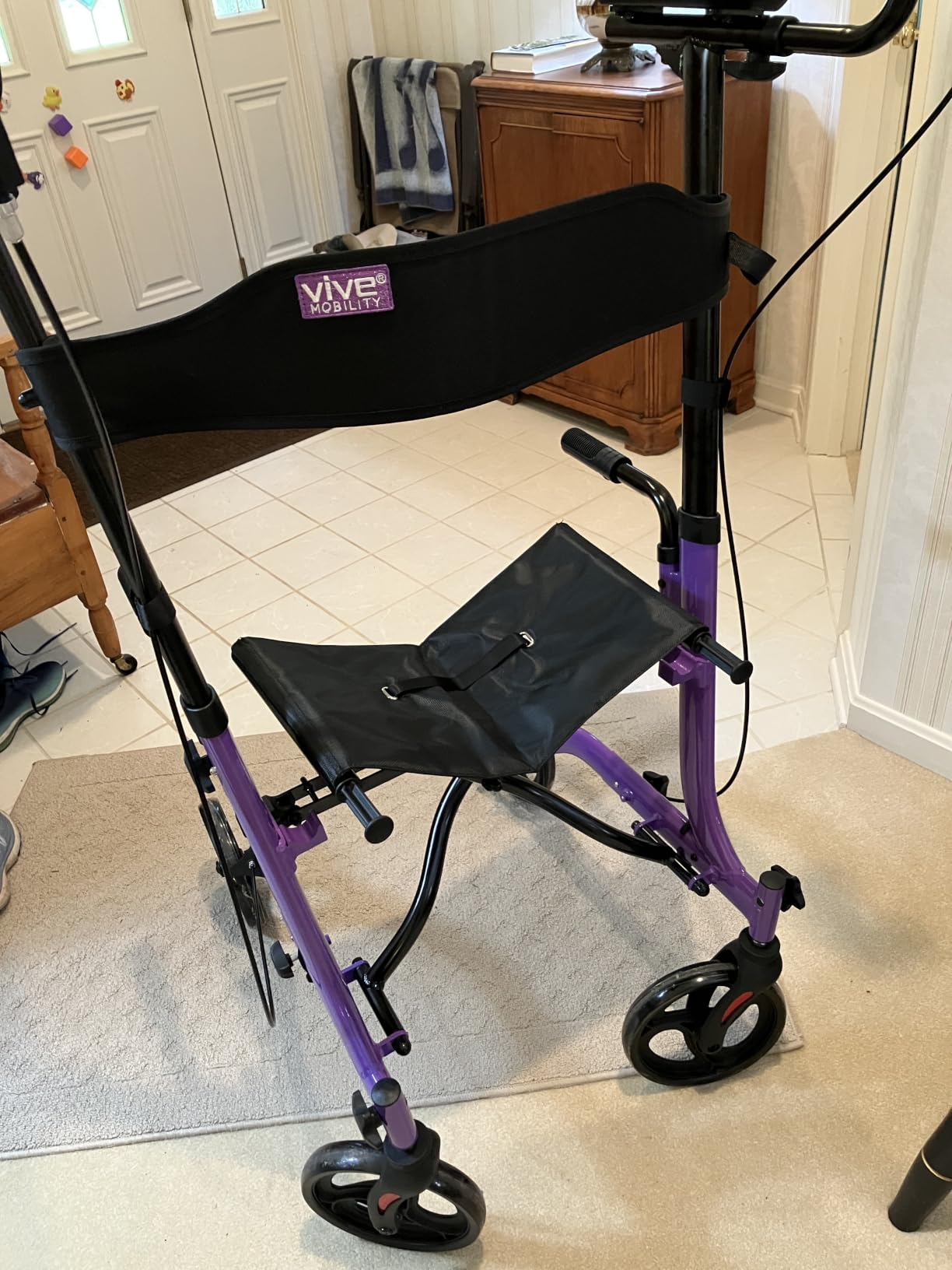
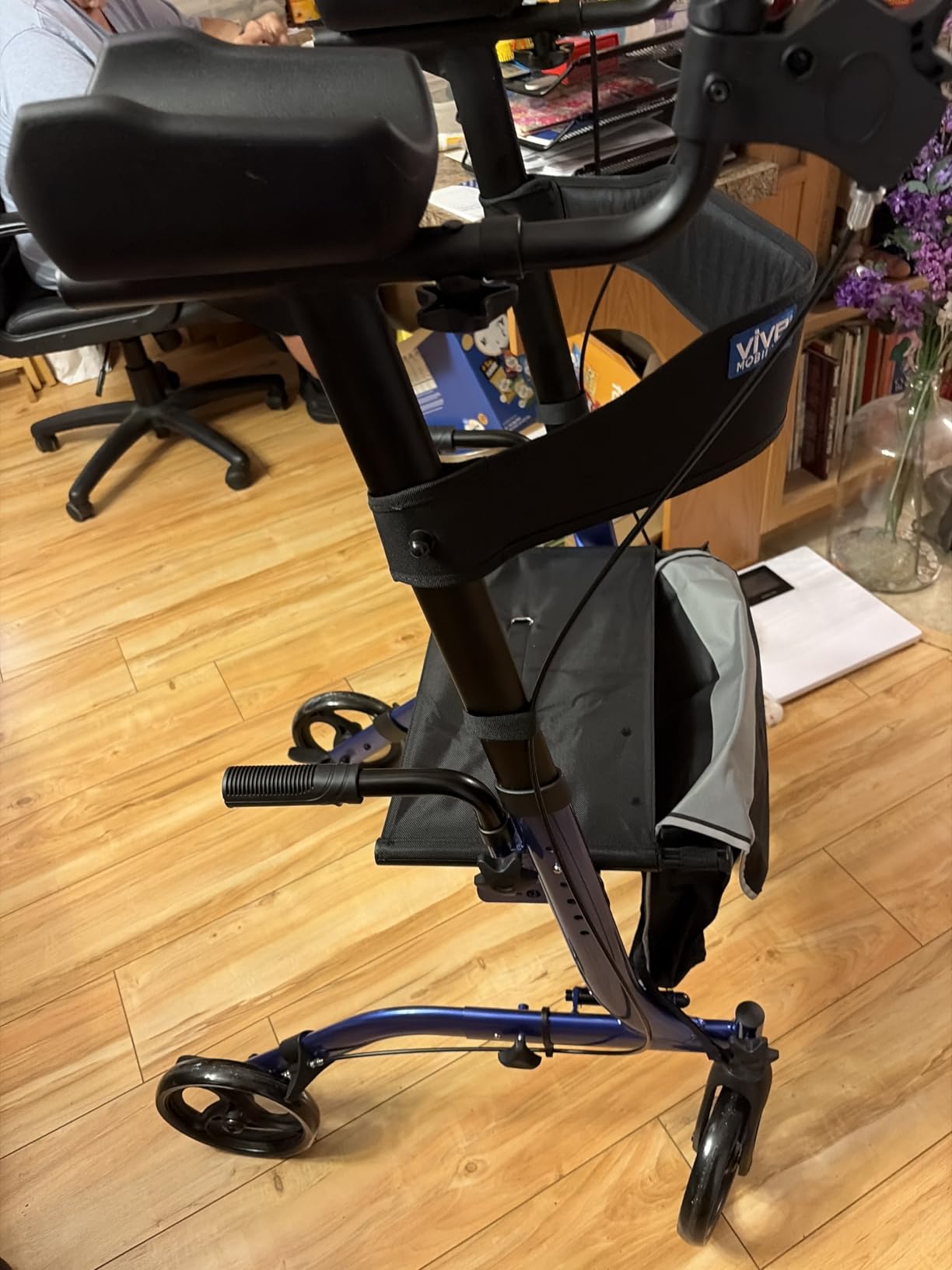
The forearm pads are unusual in this group because they slide forward and backward, not just up and down. That lets you set the contact point for your arm length rather than adapting to the frame. The contoured armrests spread pressure well when you are cruising, and the 17.5-inch seat is wider than the 15-inch seat on the 400 pound bariatric frame in this group.
Two honest weaknesses. The 8-inch flat-free wheels suit smooth ground, so treat this as an indoor-and-sidewalk machine: tile, wood, carpet, and paved paths. It does not want gravel. And several users report that the contoured armrest shape feels restrictive if your habit is to push down hard through the arms to get going, which is a real learning curve if you come from a standard rollator.
Who this suits best
Taller adults, especially anyone over 6 foot, get the fit they need here. So do users who move their aid frequently, because 20 pounds and a compact fold are the two things that decide whether an aid stays in use or stays parked.
This is also a strong pick for indoor-dominant use. If your walking is mostly hallway, apartment, and sidewalk rather than trail, the small wheels are not a limitation and the light frame is a genuine advantage every single day.
Who should skip it
Skip it if you need grip strength you are not sure you have, or if you lean heavily and want a rigid molded armrest. The contoured padding gives way slightly under aggressive loading, which some users read as a lack of support.
Skip it for unpaved outdoor routes. This frame is at its best on smooth ground, and the 4.1 rating in this group reflects the fact that some buyers wanted a stiffer armrest and bigger wheels than they got. If either matters to you, choose a heavier frame with 10-inch tires.
4. Helavo Upright Walker with Seat – Best All-Round Comfort
Helavo Upright Walker with Seat, Foldable Stand Up Walker with Rubber Tires
- Soft padded armrests and ergonomic handles for pain-free walking
- 10 inch puncture-proof rubber tires cushion outdoor surfaces
- Spacious cushioned seat with adjustable padded backrest
- Simple assembly with video instructions
- Two-year warranty extendable to three years
- Heavier than most competitors at 22.7 pounds
- 26.4 inch footprint is tight in narrow doorways
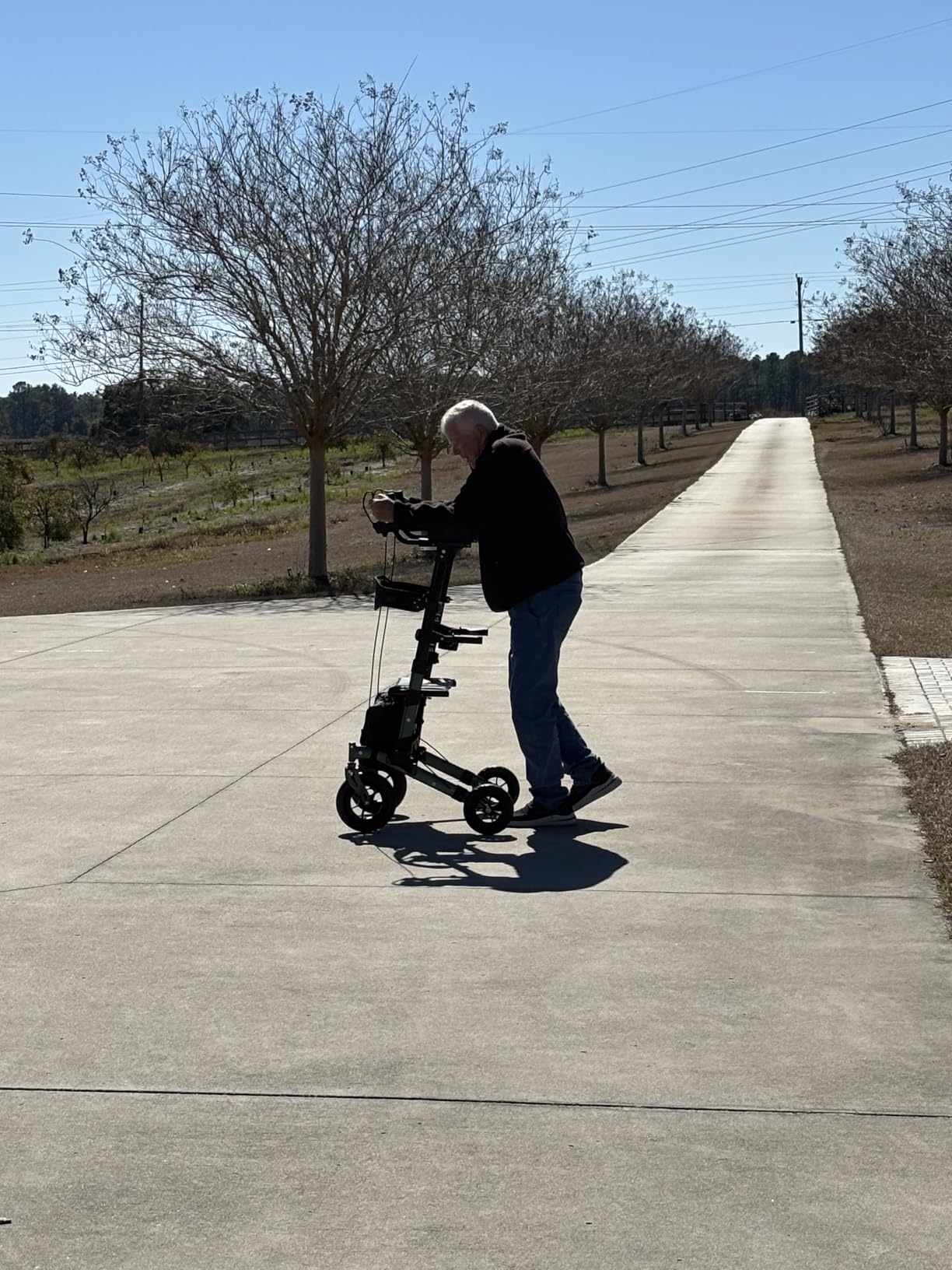
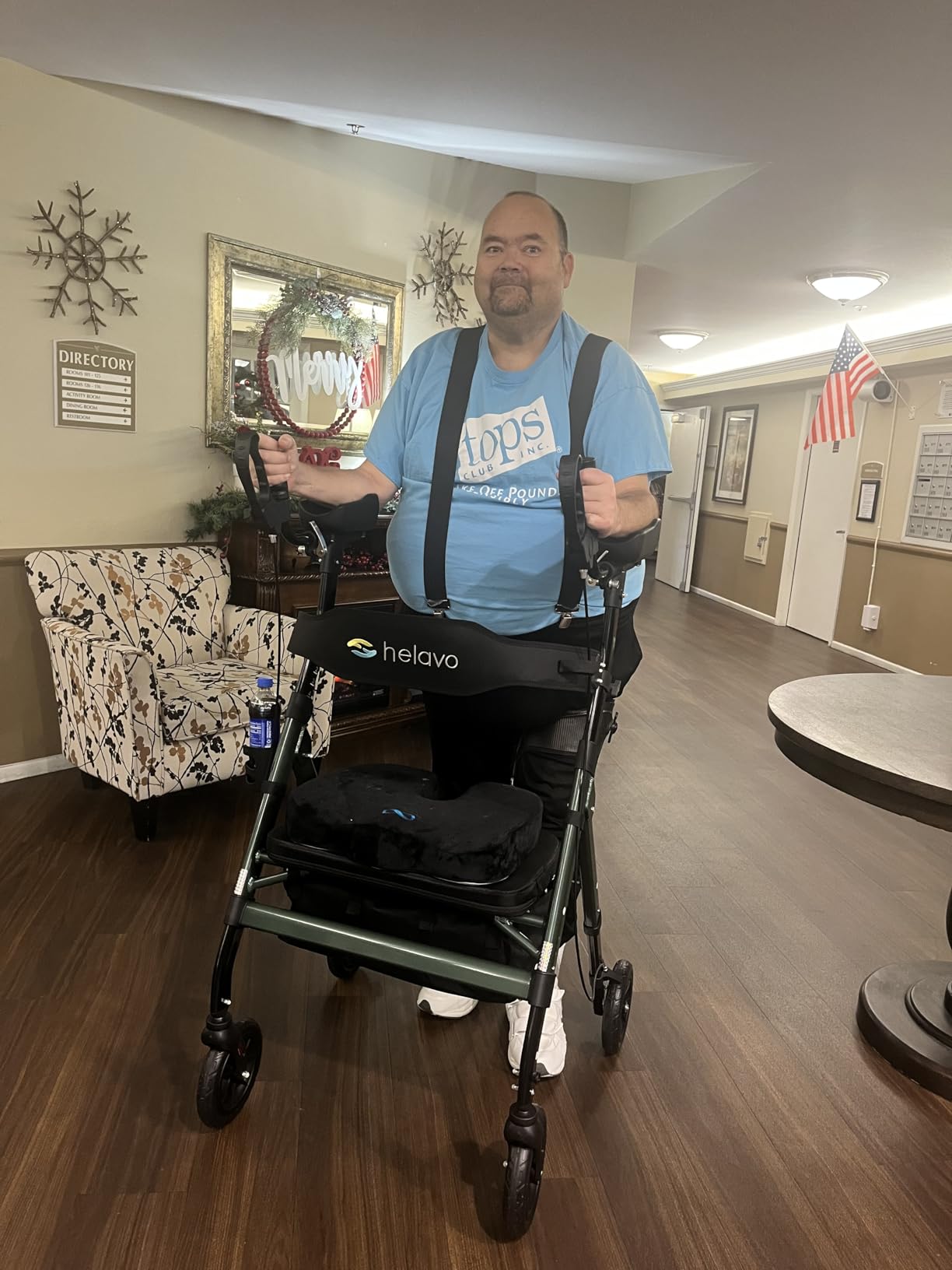
This is the one we recommend when a single product has to serve a whole household. The padding is where this model separates itself from the rest. Soft armrests, an ergonomic contoured grip, a cushioned 18.9-inch seat, and a padded backrest you can adjust means the resting position is genuinely comfortable rather than functional.
The 10-inch puncture-proof rubber front tires use a three-dimensional tread pattern, and they gave one of the smoothest rides we got over a cracked parking lot. They also absorb vibration better than hard PVC, which matters for anyone whose back is the reason they are using an aid in the first place.
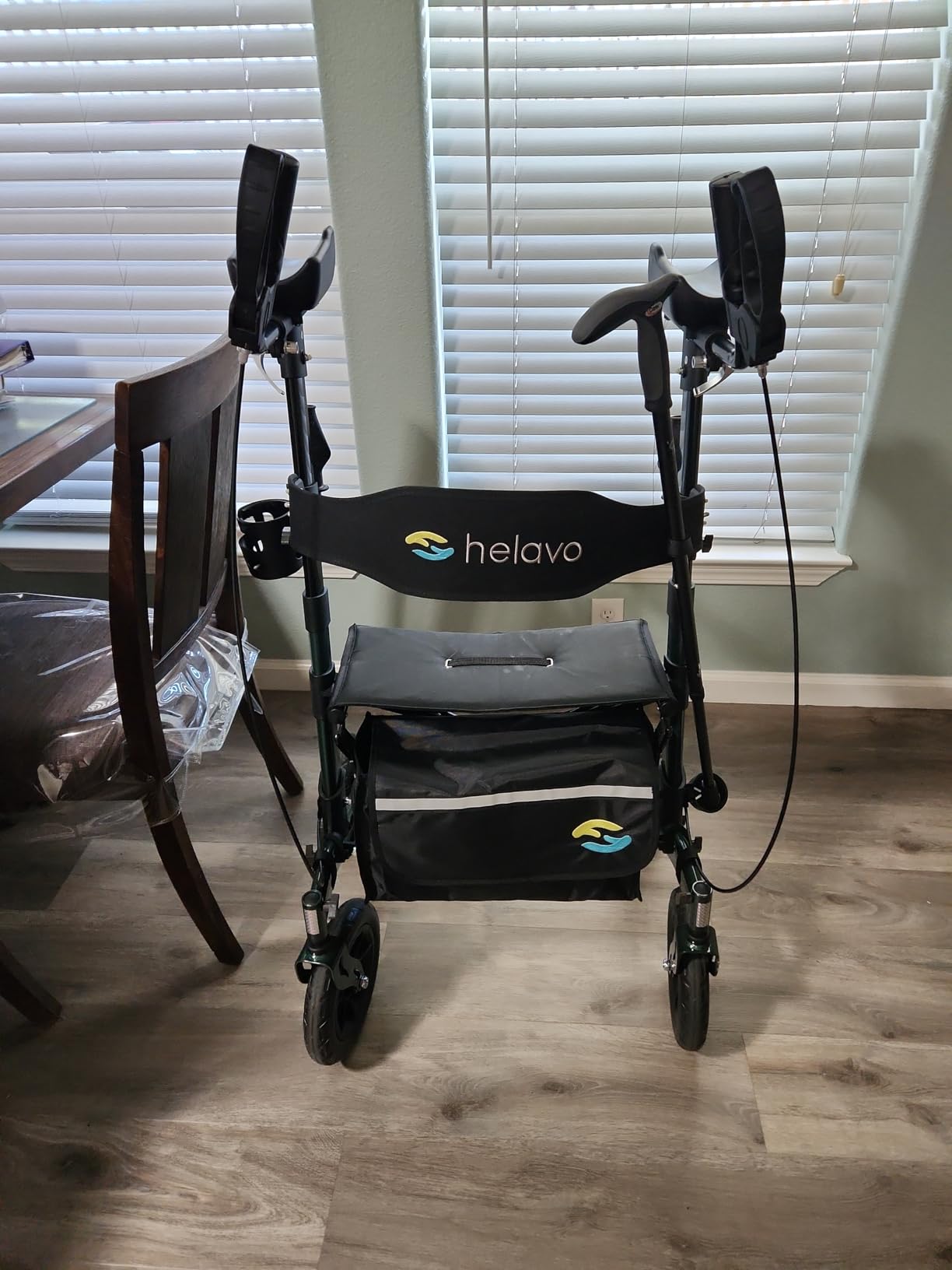
Assembly took us well under an hour with the included video, and the parking brake is easy to reach from the seated position. The package also includes a cup holder, an integrated cane holder, and a backrest that adjusts to your back rather than sitting at one fixed angle.
The warranty runs longer than most competitors manage. Two years standard, extendable to three, with round-the-clock support, which is meaningful on a frame with cables, bearings, and a brake system that will need attention over time. The 26.4-inch width is the catch: measure your doorways, because a 26 inch frame needs a wider opening than a standard interior door provides.
Who this suits best
This suits users with chronic back, hip, or knee pain who need the resting position to feel good, not just work. The cushioned seat and adjustable backrest mean a fifteen minute rest actually restores you rather than leaving you stiff.
It also suits anyone who wants a warranty behind the purchase and does not want to think about service. Mixed indoor and outdoor use is well covered by the 10-inch tires, and the accessory package removes the need to buy anything else.
Who should skip it
Skip it if you live in a small home with narrow doorways or tight corners. At 26.4 inches square the turning circle is wide, and a frame that will not fit down the hall is a frame that stays in one room.
Skip it if lifting 22.7 pounds is a strain. This is not the lightest option available, and users with shoulder problems often cannot manage that weight safely, which is an uncomfortable irony worth naming.
5. ELENKER Upright Rollator with Front Pouch – Best for Heavy Leaning
- Hard molded armrests hold up under heavy leaning
- Reinforced cross-brace improves stability over earlier models
- Smaller footprint is easier to maneuver indoors
- Front pouch keeps essentials within reach
- Handlebar seat height and grip angle all adjust
- At 26 pounds it is a two-person lift into a car
- One report of feeling top-heavy while turning
- Cup holder is large but not useful for travel mugs
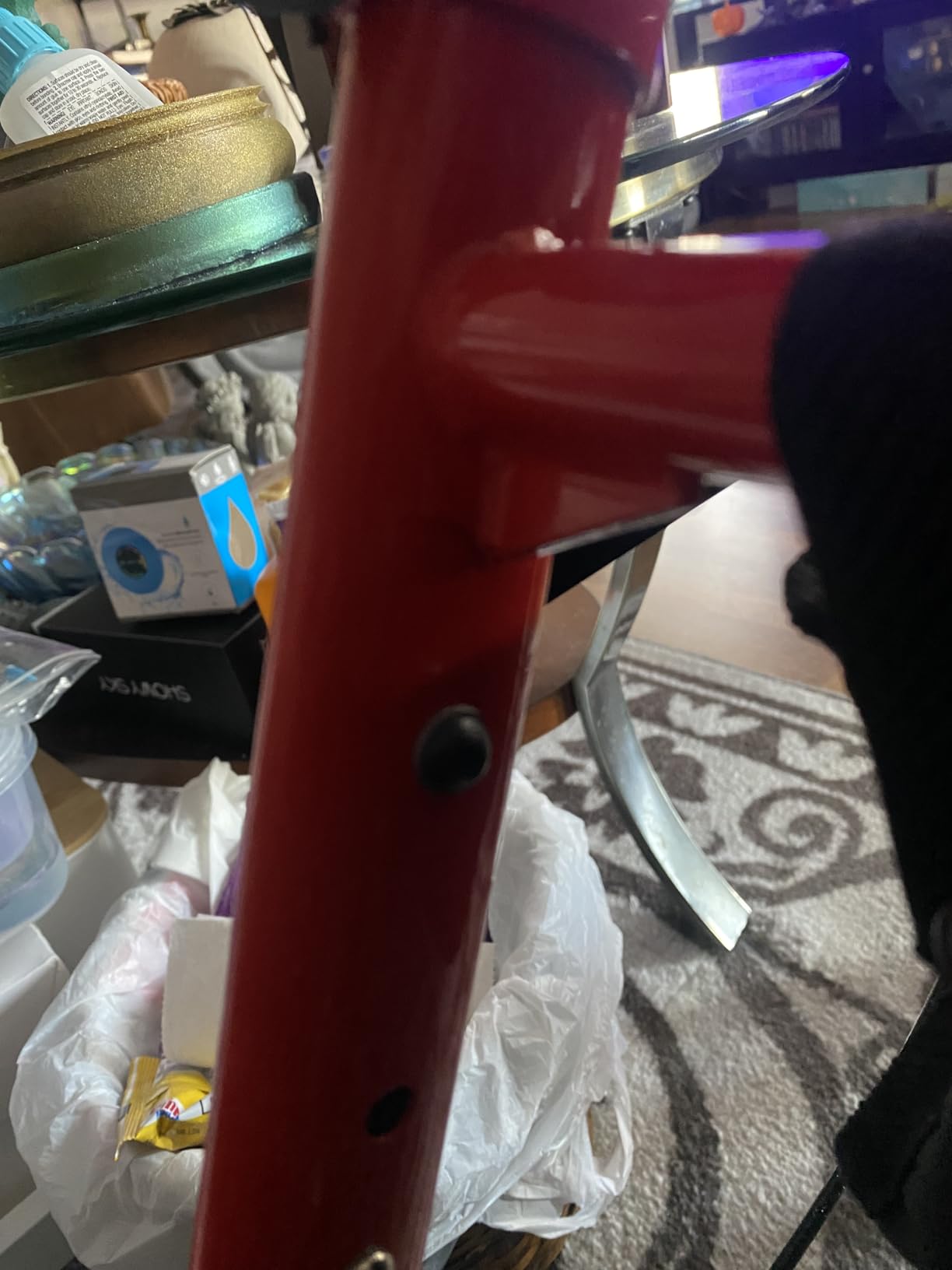
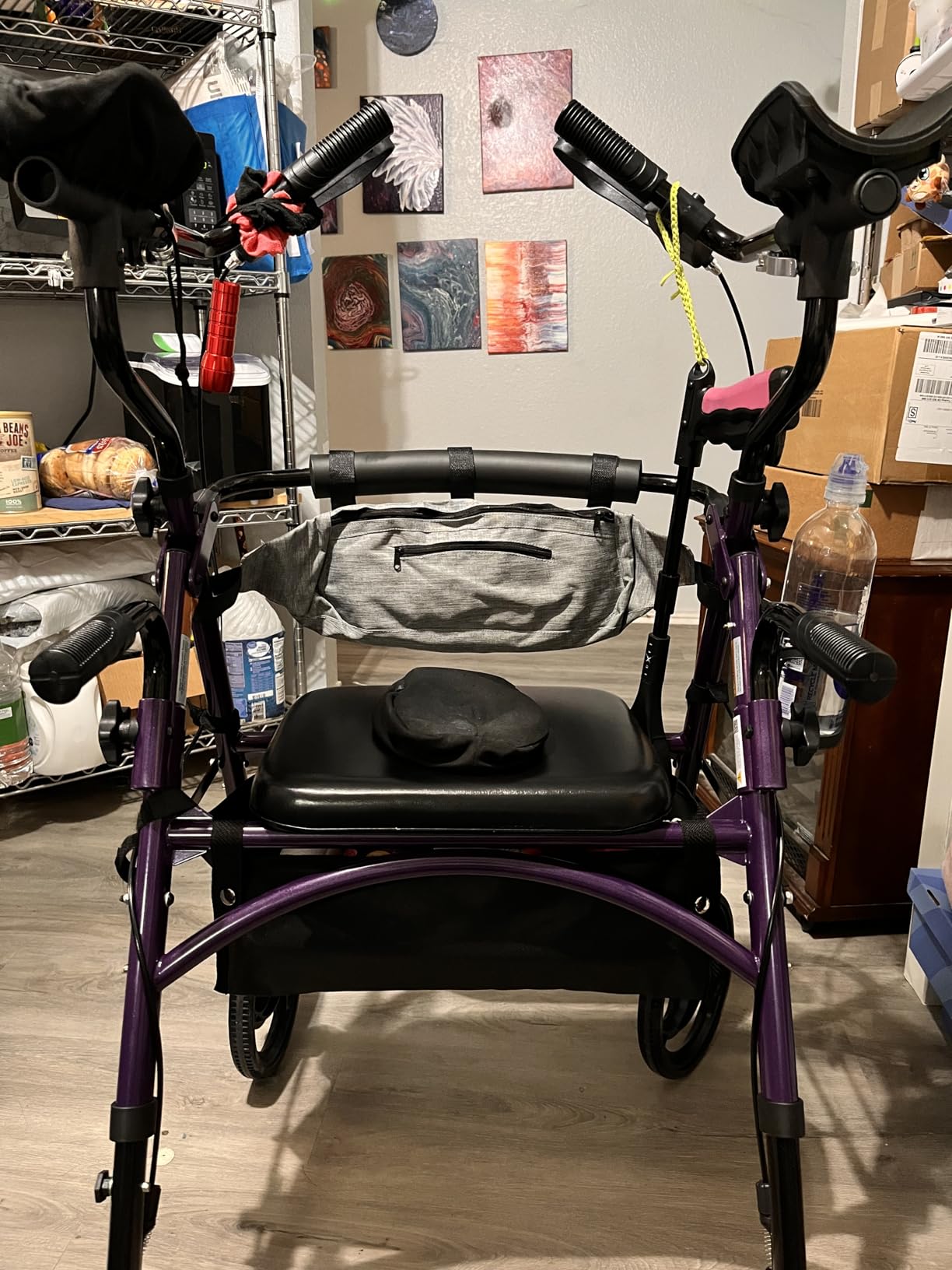
Most upright rollators use padded armrests that compress when you put real weight through them. This one uses hard molded armrests over a reinforced cross-brace, and buyers who transfer significant weight through the frame rate it highly for exactly that reason. The armrests do not flex or creak.
It is also the most fully adjustable frame in this guide. Handlebar height, seat height, and handgrip angle all move independently, and the grip angle adjustment is the one most people miss. Setting the grips to a natural inward angle is what lets your wrists relax instead of angling outward, which is where a surprising amount of hand discomfort actually comes from.
The front zippered pouch is a small detail that changes daily use. You can reach a phone, keys, or a snack without stopping, bending over, or opening the under-seat basket mid-stride. The 10-inch anti-slip tread wheels gave a solid grip on concrete and packed paths in our testing.
At 26 pounds this is heavy to lift into a car, and one reviewer reported the frame feeling top-heavy during a hard turn. That is an isolated report rather than a pattern, but if your walking involves tight pivots in confined space it is worth weighing. The listing positions the frame for users roughly 5 foot to 6 foot tall.
Who this suits best
This is the pick for anyone who leans hard into the frame, whether from fatigue, weakness, or habit. Rigid armrests mean you can push off the walker to stand up, and rigid armrests are the only kind that make that movement predictable.
It also suits users who have already worked out that their pain comes from wrist position rather than total load. The grip angle adjustment is a genuine ergonomic tool here, and there is no substitute for it on the other frames in this roundup.
Who should skip it
Skip it if you want soft padding and a plush resting surface. The molded armrests are firm by design, and users who spend a lot of time resting their forearms on the pads prefer cushioning over rigidity.
Skip it if you need to load the walker into a vehicle on your own. Twenty-six pounds with a wide frame is a two-person job, and an aid you cannot transport is an aid you will use in one room only.
6. VOCIC Z22 – Best Gel Armrest for Elbow Comfort
VOCIC Z22 Upright Walkers for Seniors with Seat, GelSoft Stand Up Walker
- Gel layer disperses elbow pressure and absorbs walking impact
- Flip-out armrest adds 4.7 in of seat width
- Handle adjusts to 47 in which suits many taller users
- Reinforced frame with 30 percent thicker tubes
- Ramp parking brake and tool-free assembly
- Seat is narrow and several reviewers could not sit comfortably
- Armrests do not swing away when sitting down
- 22 lb is bulky to load into a trunk
The gel layer on the armrests is the whole idea here, and it works. Instead of a hard rail or thin foam, a soft gel cushion spreads the load of your forearm across a wider area and absorbs the impact of each step. Users with elbow sensitivity consistently point to this as the reason they can stay out longer.
It also has a seating solution that stands out. A flip-out armrest adds 4.7 inches of seat width when you need it, which partially answers the complaint reviewers raise most often about upright rollators, that the seat is too narrow. The handlebar adjusts independently for different arm lengths, and the reinforced triangular frame uses tubes the manufacturer rates 30 percent thicker than standard.
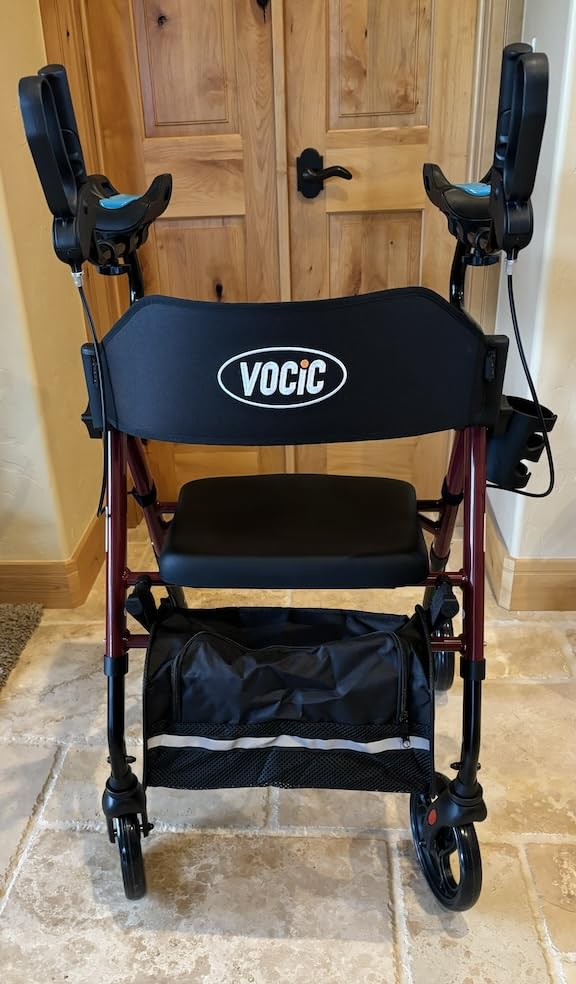
Braking is a three-mode system: squeeze up to slow, push down to lock, and a ramp parking function for slopes. That is a better-specified brake than most competitors manage, and it is the feature that gives you confidence on an incline.
The honest problem is the seat. Several reviewers report that the standard seat width is too narrow for their body, and the flip-out armrest helps but does not fully solve it. The armrests also do not swing out of the way when you sit down, so a forward-leaning sitter can bring an armrest into their face. At 22 pounds it is also bulky to load.
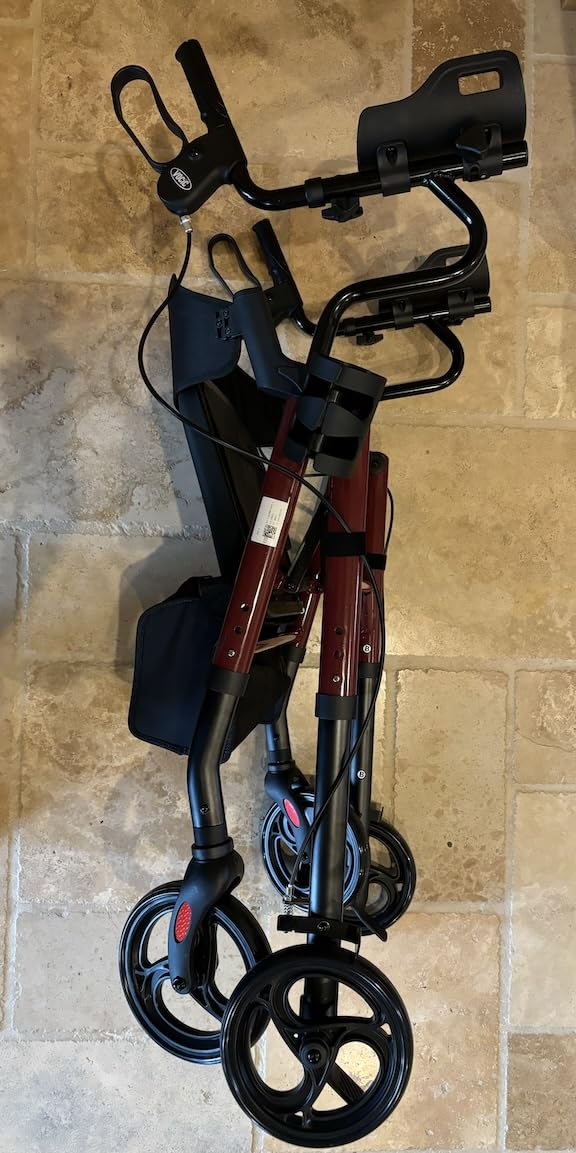
Who this suits best
This suits anyone whose elbows are the sensitive point. People with arthritis, recent elbow surgery, or a condition that makes forearm contact painful get more from this frame than from any other in the group, because the gel layer is doing genuine work rather than decorating a rail.
It also suits users who need a simple brake with a clear lock. The down-to-lock and ramp parking functions are easy to learn and easy to confirm, which matters more than brake sophistication if you are buying this for a parent.
Who should skip it
Skip it if you plan to sit down frequently and you have a larger build. The narrow seat is the most repeated complaint in the reviews, and the flip-out armrest only partly compensates. Choose a model with a wider standard seat instead.
Skip it if weak grip strength is part of your diagnosis. The brakes are hand-operated only, with no foot override, so the frame asks more of your hands than a model with a mixed brake system would.
7. Aliseniors Upright Walker – Widest Seat in This Group
- Extra-wide 20.6 inch seat gives far more room than standard models
- Light 18.76 lb aluminum frame with one-hand folding
- Adjustable armrests reduce hunched walking
- Reflective strips and polyurethane tires suit mixed terrain
- Sit-to-stand assist handles and anti-tip frame
- 28.7 inch frame width needs doorways of at least 30 inches
- 45 inch maximum armrest height is low for tall users
- 8 inch wheels are smaller than 10 inch options
The seat is the story. At 20.6 inches wide by 9.4 inches deep, this is a genuinely oversized seat, and for anyone who uses the rollator as a rest chair rather than a standing support it makes a measurable difference. Sit-to-stand assist handles are built into the frame for pushing up out of the seat.
The listed frame weight is 18.76 pounds, and the frame folds with one hand. The detachable storage bag converts into a backpack for hands-free carrying, and the anti-tip frame carries dual hand brakes rated to 300 pounds.
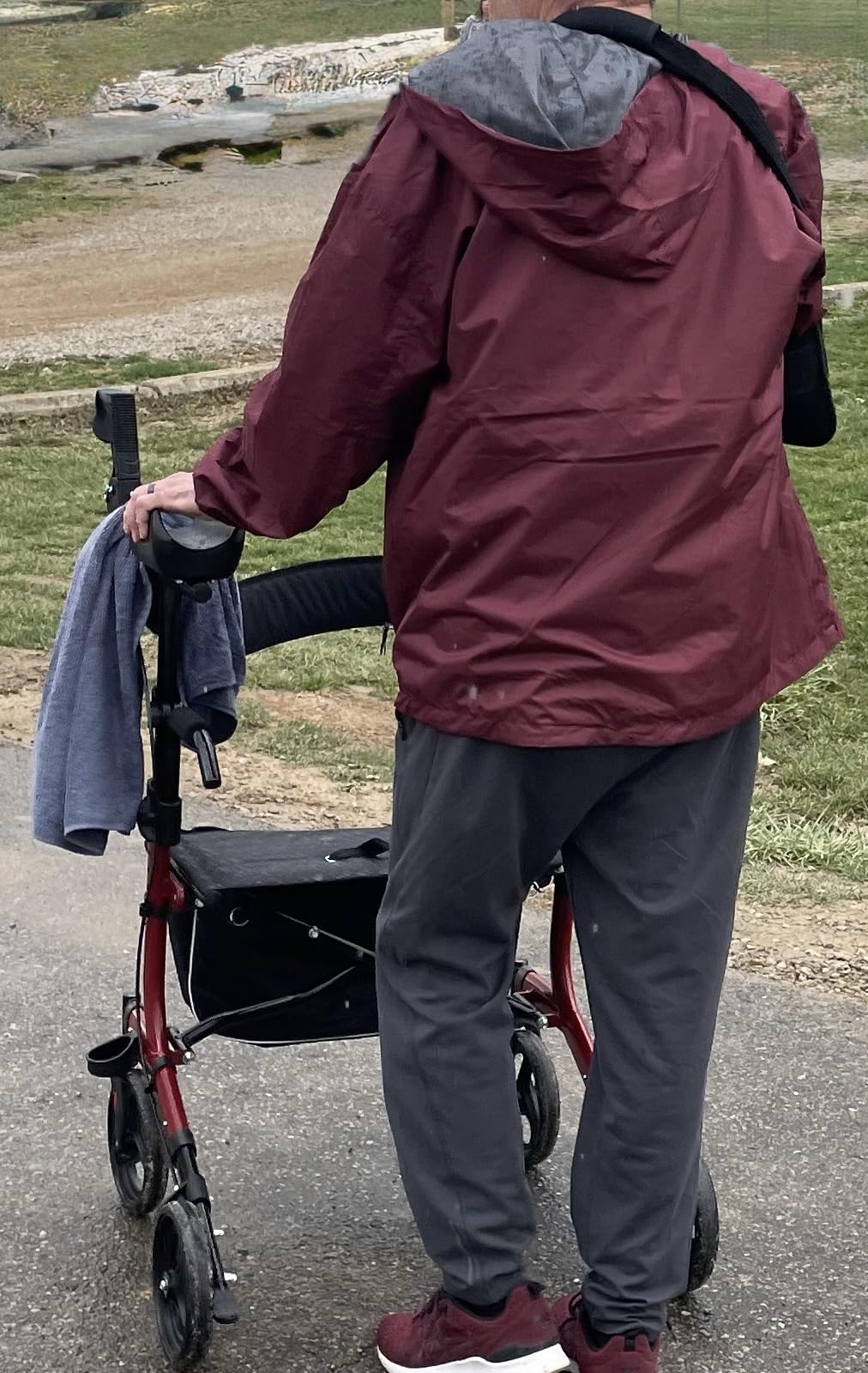
Armrests adjust from 40.4 to 45 inches and the listing positions that for users 5 foot 2 to 6 foot 2. Dual hand brakes and an anti-tip frame give solid control, and the reflective strips are a nice touch for anyone walking in low light near a road.
Here is the catch, and it is a real one. The frame is 28.7 inches wide, which is the widest in this group, and it means doorways of at least 30 inches. In a narrow home that is the difference between using the aid daily and leaving it in the bedroom. The 45-inch maximum armrest height is also low for anyone over 6 foot 2.
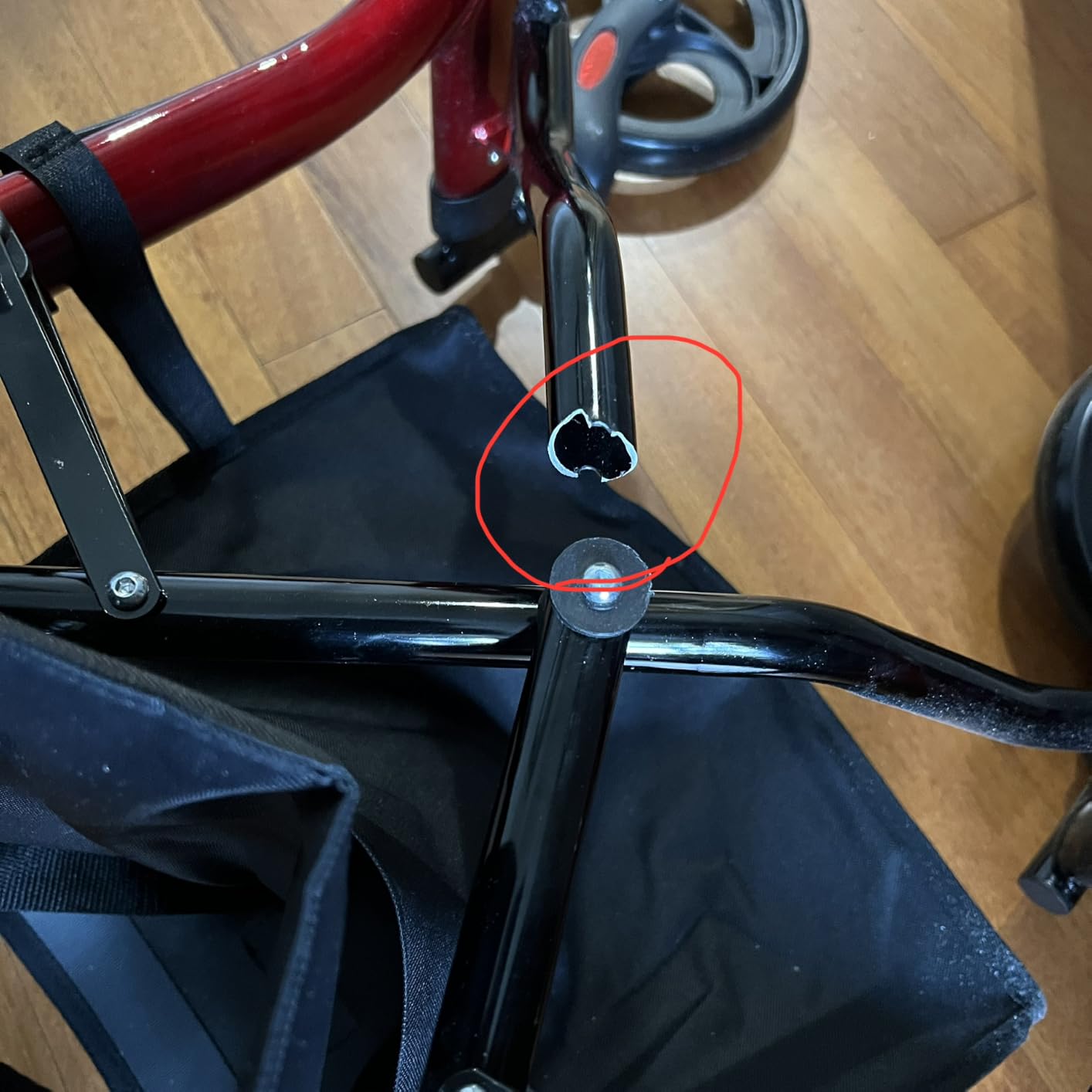
Who this suits best
This suits users who want a rollator that works as a chair. A wide seat, an adjustable backrest, and sit-to-stand handles make it practical for anyone who tires quickly, sits down frequently, or wants a place to wait comfortably rather than a perch.
It also suits users who want a light frame with a one-hand fold. That combination is rare in this category, and it makes the difference between an aid that goes out with you and one that stays home.
Who should skip it
Skip it if your home has standard interior doorways. Measure first. A 28.7 inch frame will not pass many 28 to 30 inch openings, and a mobility aid that cannot leave the room is not solving the problem.
Skip it if you are tall. The 45-inch ceiling on the armrests leaves a user over 6 foot 2 stooping, which defeats the purpose of an upright frame. Check the published height range against your own before you order.
8. KMINA Upright Walker – Best for Shorter Users
KMINA Upright Walker with Seat for Seniors, Foldable Stand Up Rollator
- Soft forearm support spreads weight and eases wrist pressure
- Lowest armrest range suits shorter users
- Brake lever pressure adjusts for easier stopping and full lock
- Rear lift levers help clear curbs and thresholds
- Folds to a compact 10 inch depth
- 44.5 in maximum armrest height suits shorter users only
- Folding takes practice and the frame is on the heavy side
- Small wheel package limits loose outdoor terrain
This is the one to look at if you are under 5 foot 2. The armrests start at 37.5 inches, the lowest floor in this group, and go up to 44.5. Almost every other upright rollator listed here bottoms out near 40 inches or higher, which leaves shorter users reaching up and bending forward, exactly the posture problem the category is supposed to fix.
The forearm support has a soft finish rather than a hard rail or a gel pad, and it spreads weight across a wider area than a bare tube. Owners point to reduced hand and wrist pressure as the main benefit, which is the reason this category exists.
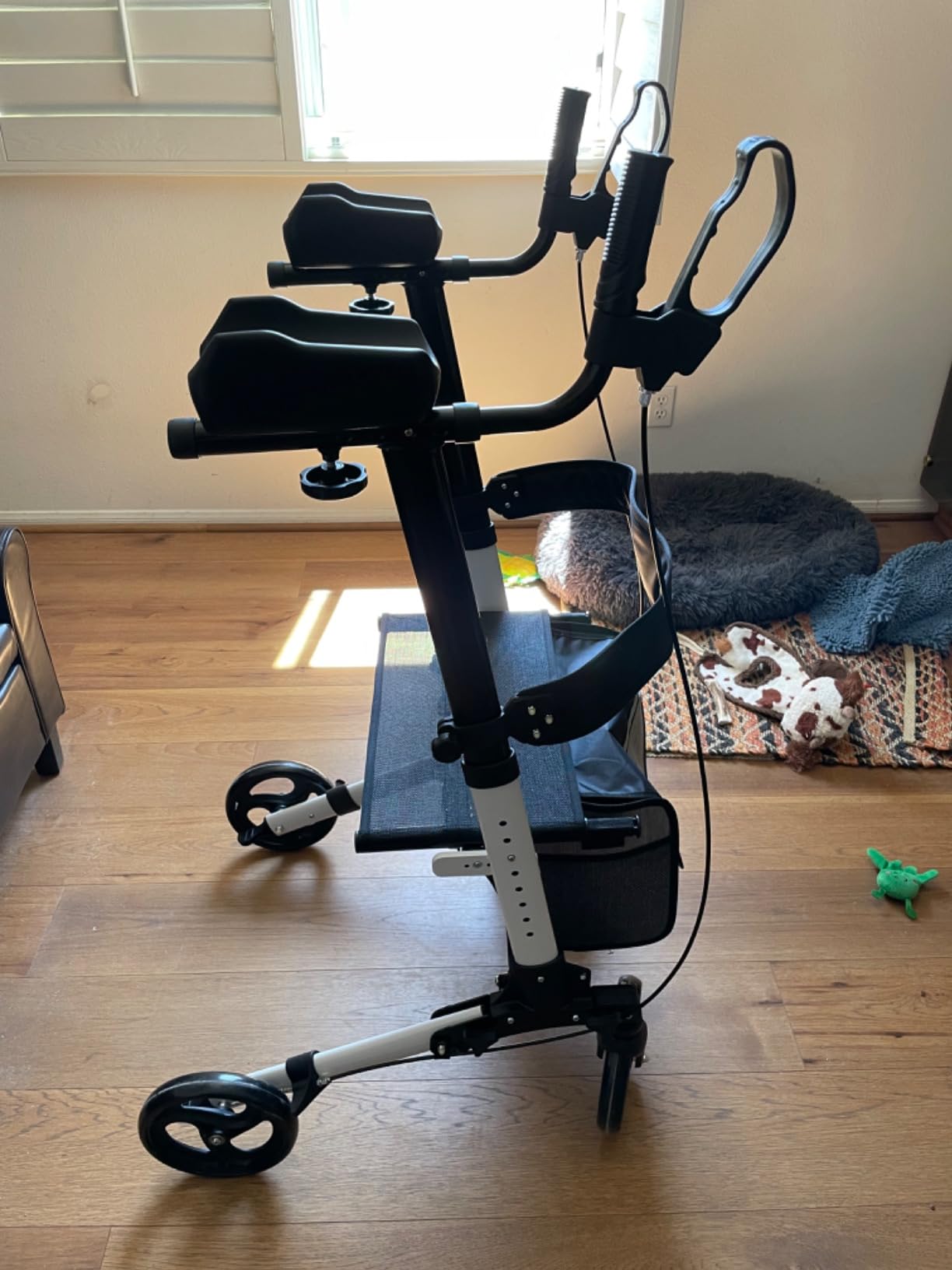
Two details stand out. The brake lever pressure is adjustable, so a user with limited hand strength can set the levers to trigger easily and still reach a full lock. And the rear wheels have lift levers, which is a genuinely useful feature for clearing a curb lip or a threshold without scraping the frame.
Be realistic about the ceiling though. Forty-four and a half inches suits shorter users and will leave anyone over 6 foot stooping. The listed recommendation is for people with medium-low dependency who are beginning to need a walking aid, and the folding takes some practice before it becomes one-handed.
Who this suits best
Shorter adults get a proper fit here, which is a genuine gap in this category. Most upright rollators are designed around a 5 foot 2 to 6 foot 2 band and quietly assume it, and this one is built lower.
It also suits anyone who needs thresholds and curbs handled gracefully. The rear lift levers are not a gimmick; they are the difference between rolling over a lip and tipping forward into it.
Who should skip it
Skip it if you are tall or near 6 foot. The top of the range is low, and stooping defeats the entire purpose. Look at a model with a 45 to 52 inch range instead.
Skip it if rough outdoor ground is part of your routine, or if you want the lightest frame available. The folding mechanism is effective but takes practice, and the wheel package is on the small side for anything loose.
9. Helavo Extra Wide Bariatric Upright Walker – Best for Heavier Users
Helavo 28.3″ Extra Wide Bariatric Upright Walker, 500 lbs Capacity
- 500 lb capacity with a 20.1 inch wide seat and backrest
- Both handle and seat height adjust
- Flat-free rubber tires absorb vibration on uneven surfaces
- Step assist and reflectors help outdoors
- Folds to 13.8 inch depth for a trunk
- 28.3 inch width requires wide doorways and vehicle openings
- Nearly 25 pounds is heavy for a user with lifting limits
- 8 inch wheels are best on paved or smooth surfaces
If you need a bariatric upright rollator, this frame carries the largest published capacity in the group and earns a 4.5 rating across 134 owner reviews. The frame supports up to 500 pounds, and the 20.1 inch wide seat and backrest are sized for a body that would sit awkwardly on a standard 17 to 18 inch seat.
Capacity is not just a number here. A standard upright rollator that is close to its limit develops a wobble, and a wobbling frame is exactly what shakes a user’s confidence and ends their walking. A frame with real headroom stays planted, and the cushioned armrests and adjustable padded backrest keep the posture benefit intact at higher body weights.
Both the handle height and the seat height adjust, with handles from 41.5 to 47.6 inches and the seat from 20.9 to 22.8 inches. The listing recommends users between 4 foot 9 and 6 foot 3. A step assist, high-visibility reflectors, a cup holder, and a cane holder round out a package that was clearly designed for regular outdoor use.
The frame is 28.3 inches wide, so it needs wide doorways and a wide vehicle opening. At nearly 25 pounds it is heavy, and that matters most for the exact user this product is built for. Plan the loading before you commit rather than after.
Who this suits best
This suits users above 300 pounds, who are outside what a standard upright rollator can safely carry. The combination of a 500 pound rating, a genuinely wide seat, and a wide stance base is what stops the frame from twisting under load.
It also suits anyone who needs the resting position to accommodate a larger body. A 20.1 inch seat with a padded adjustable backrest is the difference between resting and enduring, and enduring is what makes people stop using their aid.
Who should skip it
Skip it if your home is narrow. Twenty-eight inches of width will not clear many doorways, and if the rollator cannot move between rooms it fails at the job regardless of how well it is built.
Skip it if you need serious all-terrain capability. The 8-inch flat-free tires are comfortable and shock absorbing on pavement and packed paths, but they are not built for gravel, sand, or roots.
10. Vive Bariatric Upright Walker – Best 400 lb Capacity
Vive Bariatric Upright Walker for Seniors (400 lb)- Stand Up Walker w/Seat
- 400 lb frame with a wider base for stability
- Handles adjust 40-50 in for users 5 ft to 6 ft 4 in
- 9.5 inch flat-free tires work indoors and out
- Padded 15 by 17 inch seat with under-seat tote
- Folds flat for car truck or SUV transport
- 25 pounds is heavy for users with limited lifting ability
- 9.5 inch wheels are smaller than 10 inch all-terrain options
- 28 inch base takes up space indoors
This is the middle ground in bariatric upright rollators. The frame supports up to 400 pounds, which covers most users who are above the 300 pound limit of a standard upright rollator without moving to a 500 pound frame, and the wider base is what gives it its planted feel when you put weight through the armrests.
The handle range is the quiet strength. Forty to 50 inches is a wide adjustment for a bariatric frame, and the listing positions it for users from 5 foot to 6 foot 4, so a taller user above 6 foot is less likely to end up stooping than on a narrower bariatric range. Loop brakes and contoured armrests with ergonomic grips complete a well-specified package.
The 9.5-inch flat-free tires are a sensible middle ground for someone who splits time between indoors and a paved sidewalk. They roll over indoor transitions without catching, and they do not need inflating or replacing. The under-seat tote keeps essentials within reach while you walk, and the padded 15 by 17 inch seat is comfortable for a planned rest.
At 25 pounds with a 28 inch base, the weight and bulk are the tradeoffs. Bariatric frames are heavy by nature, and the reality is that loading one into a vehicle needs two people or a ramp. A one-year guarantee covers the frame.
Who this suits best
This suits users between roughly 300 and 400 pounds who want a bariatric upright rollator without moving up to a very wide extra-wide frame. The 28 inch base is wide but not extreme, which makes it easier to maneuver than a 30 inch bariatric design.
It also suits taller bariatric users. The 50 inch maximum handle height and the stated 6 foot 4 upper limit give more headroom than most bariatric upright rollators offer, which matters because a short maximum height causes stooping.
Who should skip it
Skip it if you are above 400 pounds, where you need the extra headroom of a 500 pound frame. Skip it if you lift the aid yourself, because 25 pounds with that base is not a solo job.
Skip it if your surfaces are loose gravel or uneven ground. The 9.5 inch wheels handle pavement and indoor transitions well and everything else poorly.
Why Upright Rollators Change Your Posture
The benefit is mechanical, not marketing. Push down on a standard rollator and the force path runs from your hands through your wrists, into your shoulders, and out through a trunk that has to lean forward to keep the walker ahead of you. That forward lean is the posture problem, and it is why standard rollator users so often end up with wrist, hand, or shoulder pain within weeks.
An upright rollator moves the contact point to the forearm. Your weight rests along the length of the forearm rather than being concentrated in the palm, the shoulders do not have to hold the frame in front of you, and the trunk can stay stacked over the hips. Because the frame sits ahead rather than around you, you can keep your head up and look where you are going.
That has a practical consequence that matters more than the ergonomics. An aid that hurts gets abandoned. People managing chronic back and hip pain describe the same pattern: legs or back give out after about ten minutes, and if the aid does not provide a supported resting position, the outing ends there. The forearm support plus a proper seat combination is what turns a short walk into a long one.
It is worth saying clearly that this benefit is real but not universal. If you have no wrist or shoulder strain, sit comfortably in a standard rollator, and value a lighter frame and a tighter turning radius, you will get very little from the upright format and will pay for it in weight and width.
Desk-bound hours wreck posture in a completely different way that no walking aid can fix, and if posture is your concern rather than mobility alone, our posture corrector roundup and under-desk footrest guide cover the other half of the problem.
How to Set the Right Armrest Height
Set the armrests so your forearms rest on the pads with your elbows bent roughly 15 to 20 degrees and your shoulders relaxed, not shrugged. A useful starting point is the wrist crease height: stand straight, and the armrest should land near the crease of your wrist when your arm hangs naturally. Most people set the armrests too high, which produces the exact hunched posture they are trying to avoid.
Check the published range before you buy, because it varies enormously. In this group the armrest range runs from 37.5 inches at the low end to 52 inches at the high end, and that spread is the difference between a comfortable fit and a permanent stoop. Users well over 6 feet are the group most often stuck, because most upright rollators top out around 45 to 47 inches.
Users under 5 foot 2 face the mirror problem, since a minimum height near 40 inches leaves them reaching up. A model that starts at 37.5 inches fits a much shorter adult properly. Seat height is a separate adjustment, and getting it wrong is uncomfortable rather than harmful, so set that to land you with your feet flat and your knees at roughly a right angle.
Finally, recheck the setting every few weeks. People lose a little shoulder range as they adapt, and an armrest that was perfect a month ago starts to feel high. A quarter turn on a lever takes ten seconds.
Buying Guide: Choosing an Upright Rollator in 2026
Five decisions decide whether an upright rollator works for you: whether you need forearm support at all, whether the frame fits your body, what you will roll it over, how the seat and brakes behave, and whether you can actually get it in and out of your home. Work through them in order and the spec sheet stops being abstract.
1. Confirm you need forearm support. The clearest signs are wrist or hand pain after using a standard rollator, shoulder aching by the end of an outing, or a forward head and rounded back that only appear while walking. If none of those apply, read the section on standard rollators below before spending more.
2. Match the armrest range to your height. Check the published range, not a marketing claim. The picks in this guide span 37.5 to 44.5 inches for shorter users, 40 to 47 inches for the middle, and 45 to 52 inches for taller adults. Anything above 6 foot 3 should be looking at the upper end of that band. If you are under 5 foot 1, a low-starting range matters more than anything else on the spec sheet.
3. Pick wheels for your actual surfaces. Wheel size is the single biggest driver of how a rollator feels. 8-inch flat-free wheels are smooth and quiet on tile, carpet, and pavement, and they get caught on gravel and lawn. 10-inch wheels handle cracked sidewalks, park paths, and packed dirt with far less judder. Larger airless PU tires add shock absorption that most people with back pain notice immediately. Choose for the worst surface you actually walk on, not the best one.
4. Look at the seat and the brakes together. A seat that is too narrow means every rest is uncomfortable, which is a fast route to not resting at all. Check the seat width against your hips, and check whether the armrests swing out of the way when you sit down. On brakes, look for a clear downward lock you can feel engage, and a parking function if you sit on slopes. A brake you cannot confirm is locked is a brake you will not trust.
5. Verify the fit in your home before you commit. Measure the narrowest doorway on your route and the opening of your vehicle. Frames in this group run from about 22 inches wide to nearly 29 inches wide, and the widest ones need 30 inch openings. Check your weight against the published capacity and leave headroom rather than sitting at the limit.
A note on tiers. The entry-level upright rollators in this group use padded or molded armrests, 8-inch wheels, and a basic brake, and they are a perfectly sensible choice for indoor and paved use. The mid tier adds 10-inch rubber or PU tires, adjustable backrests, and better warranties. The upper tier is where bariatric frames and premium armrest materials live. You do not need the top tier to get the posture benefit, which comes from the forearm support, not the price of the frame.
On coverage, rollators and upright walkers are usually not a standard covered item under original Medicare, and private plan rules vary widely. The mechanism worth checking is a Medicare-enrolled durable medical equipment supplier with a written prescription and a documented mobility limitation on file. Confirm the specific rules with your own plan and supplier before you buy, and assume you are paying out of pocket otherwise.
When a Standard Rollator Is the Better Choice
A standard rollator wins on weight, width, stability, and price in every category, and for some people that is the correct trade. The typical two-wheel or lightweight four-wheel rollator weighs a fraction of these upright frames, turns in a much tighter circle, and gives you a firmer point of contact for pushing off. If you have no wrist or shoulder pain, no hunching problem, and no need to sit down frequently, the upright format gives you very little.
Consider a standard rollator instead if your walking is short distances indoors, if you need the aid to fit through narrow doorways or into a small trunk, if you are under the weight where a heavy frame is manageable, or if you value maximum stability above all else. The heavier upright frames are less planted under a hard push, and that is a genuine safety consideration rather than a preference.
There is also a middle option: a Euro-style rollator with a tall handlebar and handgrips. It is lighter than a true upright rollator and gives you a more upright hand position, but it has no padded forearm armrests, so the wrist and shoulder loading is only partly solved. It is a reasonable choice for a user who wants more upright posture without the bulk.
Brake Safety and Basic Maintenance
The most common real-world failure with any rollator is sitting down without locking the brakes. On most of these frames the rear wheels roll freely, and if you lower yourself onto the seat before the lock engages, the frame can roll out from under you. Get into the habit of pushing both brake handles down fully, feeling the lock engage, and only then sitting. Test the lock once a week with the frame empty.
Check your brake cables monthly for fraying and make sure the cables are not snagging on the frame as you fold it, which is a common cause of a brake that stops working properly. Inspect the wheels for flat spots and confirm they spin freely, and keep the wheel axles free of hair and grit.
For anything wobbling, tighten the frame bolts before assuming the frame is faulty. And respect the published weight capacity. Exceeding it does not produce an obvious failure, it produces a frame that twists slightly, and that is exactly the instability that makes users stop walking.
Frequently Asked Questions
What is the best upright rollator?
For most adults who need forearm support and weigh under 300 pounds, the ELENKER Upright Walker is the best overall pick. It has the longest owner history in this group, a reliable lockable brake, and a 38 to 47 inch armrest range. If you need larger wheels for outdoor paths, choose the ELENKER All-Terrain version instead. If you are over 6 foot 3, prioritize a model with a 50 inch or higher maximum handle height.
Do upright rollators actually help posture?
Yes, and the reason is mechanical. A standard rollator is pushed down through the hands and wrists, which rounds the back forward and loads the shoulders. An upright rollator raises the contact point to the forearm, so the trunk stays stacked over the hips and the weight comes off the wrists. The benefit is largest if you already have wrist, hand, or shoulder pain from a standard rollator.
Will Medicare pay for an upright rollator?
Usually not as a standard benefit. Original Medicare does not routinely cover rollators or upright walkers as a listed item, and private plan rules differ. The route worth checking is a Medicare-enrolled durable medical equipment supplier with a written prescription and a physician-documented mobility limitation. Confirm the specific rules with your plan and supplier before buying, and assume out-of-pocket cost otherwise.
Is an UPWalker better than a rollator?
An UPWalker is a large-frame forearm-support walker, usually a heavier fixed frame rather than a folding rollator. It is more stable and better for prolonged standing rests, but bulkier and less portable. A true upright rollator gives you the same forearm-supported posture benefit in a frame that folds and weighs less. Choose an UPWalker if you need maximum frame rigidity and rarely travel with the aid; choose an upright rollator for everyday portability.
Can an upright rollator be used outdoors?
Yes, provided you match the wheels to the surface. Models with 10-inch puncture-proof rubber or PU tires handle cracked pavement, park paths, and packed dirt well. Models with 8-inch flat-free wheels are built for indoor floors and smooth pavement and will catch on gravel and lawn. Wheel size, not the upright format, is what determines outdoor performance.
How do I know my upright rollator is the right height?
Rest your forearms on the armrests with elbows bent about 15 to 20 degrees and shoulders relaxed. A good starting point is wrist crease height with your arm hanging naturally. If your shoulders are shrugged or you are leaning forward, the armrests are set too high. Recheck the setting every few weeks, since a frame that felt right a month ago can start to feel high.
Which Upright Rollator Should You Buy?
Start with the ELENKER Upright Walker if you want one dependable default. It has the deepest owner history in this group, a lockable brake that works, and a frame that stays planted when you lean on it. If you walk outdoors on anything rougher than pavement, take the all-terrain version with 10-inch PU tires and adjustable armrest angle instead.
Match the frame to your body before anything else. Taller users want a high maximum armrest height, shorter users want a low minimum, and anyone above 300 pounds wants a bariatric frame rather than a standard one pushed to its limit. If you have elbow pain specifically, the gel armrests on the VOCIC Z22 are the feature that will matter most. Whatever you pick, measure your doorways first, set the height properly before your first walk, and lock the brakes before you sit.
Our other posture and comfort picks are in the posture corrector roundup and the under-desk footrest guide, both of which address the same desk-bound half of the posture problem this category cannot touch.